


A new generation of silicon carbide power devices introduces top-side cooling in a surface-mount package, enabling higher output power, improved thermal performance, and greater design flexibility for EVs, renewable energy systems, and datacenter power infrastructure.
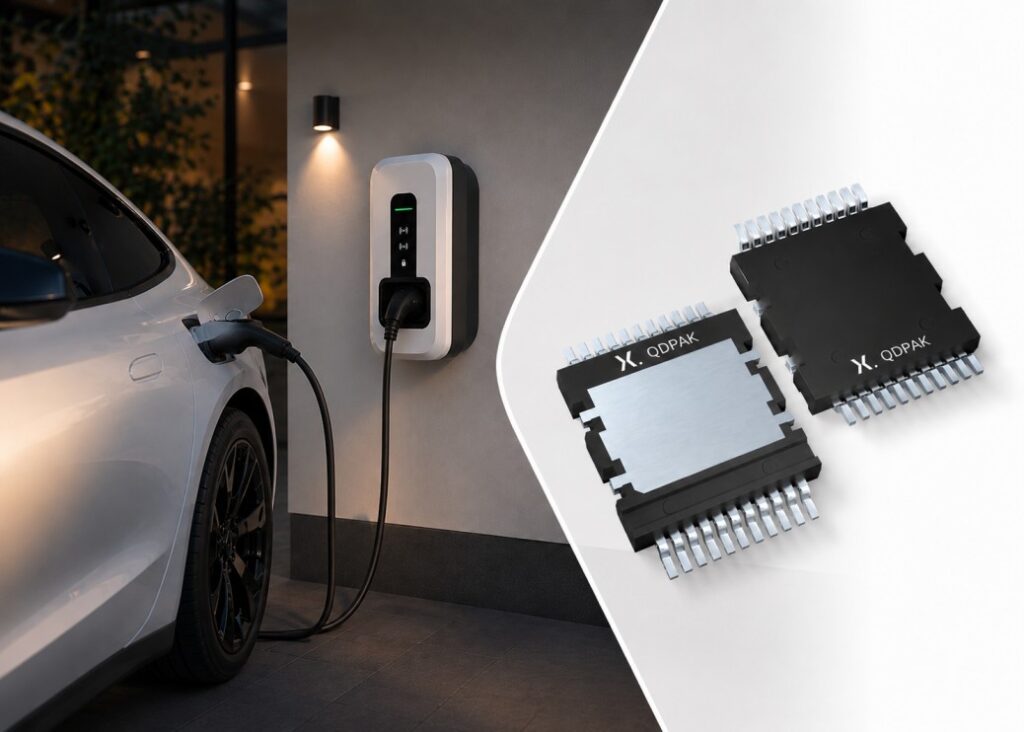
As power electronics designers push for higher efficiency and power density, thermal management remains one of the biggest challenges in high-voltage systems. A new family of 1200 V silicon carbide (SiC) MOSFETs from Nexperia aims to address that issue by combining wide-bandgap performance with a top-side-cooled, surface-mount package designed to improve heat dissipation and simplify system integration.

The devices are housed in a QDPAK package that creates a direct thermal path from the semiconductor die to an external heatsink. This approach reduces dependence on the printed circuit board for heat spreading, allowing the semiconductor and PCB to be thermally managed more independently. The result is improved cooling efficiency in applications where thermal constraints often limit overall system performance.
The key features are:
- 1200 V SiC MOSFETs in top-side cooled QDPAK package
- RDS(on) options from 17 mΩ to 80 mΩ
- Up to 3 kW higher output power versus conventional D2PAK-7 designs
- Around 40°C additional thermal headroom at comparable power levels
- Kelvin source pin for improved switching performance and EMI control
According to the company, the package can deliver up to 3 kW more output power than conventional D2PAK-7 solutions under comparable thermal conditions. It also provides around 40°C of additional thermal headroom at the same power level. Compared with existing top-side-cooled package platforms, the design can support roughly 3 kW more power handling while offering approximately 23°C of additional thermal margin.
The portfolio includes industrial- and automotive-qualified variants with on-resistance options ranging from 17 mω to 80 mω. This allows engineers to select devices optimised for both compact and high-power applications while balancing efficiency, thermal performance, and mechanical design requirements.
Target applications include EV onboard chargers, high-voltage DC-DC converters, charging infrastructure, photovoltaic inverters, uninterruptible power supplies, industrial motor drives, and datacenter power systems. These sectors are increasingly adopting SiC technology to improve conversion efficiency and reduce system size.
Beyond thermal improvements, the devices feature stable RDS(on) characteristics across temperature ranges, helping maintain predictable conduction losses at elevated operating temperatures. A low-inductance package structure and controlled switching behaviour contribute to efficient operation, while an integrated Kelvin source pin supports faster switching and improved control of EMI, ringing, and transient effects.
Click here for the original announcement.