




Food may look fine but still be unsafe. A sensor can detect spoilage gases and hidden allergens that human smell often misses.
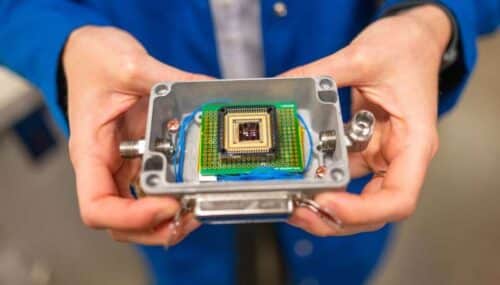
An electronic nose developed at UC Berkeley can detect food spoilage gases and allergens like peanuts and walnuts more accurately than human smell. The system can identify very small traces of food-related compounds, including about 0.05 grams of walnut, and distinguish between fresh and spoiled items such as milk, eggs, and raw chicken.
The device uses 16 gas sensors, each responding differently to airborne chemicals. When exposed to a smell, the sensors produce electrical signals that form a combined pattern. Machine learning is used to match these patterns to specific foods and conditions, including freshness over time.
In tests, the system was trained on the smell profiles of fruits and nuts such as strawberry, blueberry, banana, walnut, hazelnut, cashew, and peanut. It also tracked how the smell signatures of chicken, milk, and eggs changed after 24 and 48 hours at room temperature. This allows it to separate fresh food from spoiled food based on gas signatures.
The sensing chip relies on carbon nanotubes as the conductive material. These allow ultra-thin sensing layers that work at room temperature. This design also enables the use of different sensing materials, including polymers that would not survive high heat, and simplifies fabrication through drop casting.
Each sensor acts like a separate “chemical channel,” and the system reads the combined output as a smell fingerprint. Machine learning then classifies these fingerprints into food types or spoilage states.
Electronic nose systems have existed for decades, but integrating multiple sensing materials on a single chip has been difficult. The Berkeley approach focuses on simplifying this integration while improving sensitivity and expanding detectable food types.
A portable version linked to a smartphone app has already been developed, and future work will focus on testing the system in more complex real-world environments like refrigerators and mixed food conditions.

