This article explains electronic skin (e-skin)—what it is, how it works, the materials and sensors involved, how it is manufactured, and how it is transforming industries such as robotics, prosthetics, healthcare, and wearable electronics.
What if machines could truly feel? E-skin is bringing human-like touch to robotics, prosthetics and healthcare, redefining how intelligent devices sense and interact.

Imagine a world where machines can feel the world as we do: a gentle breeze, the firmness of a handshake, or the warmth of a coffee mug. This is no longer the domain of science fiction; it is the unfolding reality of electronic skin, often known as e-skin, which is revolutionising technology at the intersection of electronics, materials science, robotics, and healthcare.
E-skin refers to thin, flexible, stretchable layers embedded with sensors that replicate the sensory functions of human skin, creating digital touch for machines, prosthetics, robotics, and wearable health devices. Innovations in this area have enabled the development of artificial surfaces that can detect pressure, temperature, strain, humidity, vibration, or motion, and even offer electro-tactile feedback, allowing machines to interact with their surroundings more profoundly and naturally than ever before.
Building blocks of e-skin
At the heart of e-skin technology lies a synergy of advanced materials, manufacturing methods, and sensor technologies, all designed to make devices sensitive, adaptable, and comfortable. The foundation of any e-skin is its substrate: a layer that must be flexible, biocompatible, stretchable, lightweight, and durable. Materials like polydimethylsiloxane (PDMS), thermoplastic polyurethane (TPU), silicone elastomers such as Eco Flex and Dragon Skin, and biomedical hydrogels are widely used to build this all-important support base.
These materials are soft and conformable to the unique surfaces of the human body or robotic limbs, providing comfort and mechanical stability without interfering with sensor operation

How e-skin senses touch
Central to e-skin’s sensing ability are the state-of-the-art mechanisms layered within or on top of these substrates. Capacitive sensors detect touch and pressure by recording changes in capacitance as the e-skin deforms. Piezoelectric materials generate voltage when compressed or stretched, making them ideal for capturing data about motion and vibration. Thermoresistive elements respond to temperature fluctuations, providing vital information about ambient or body heat. Triboelectric sensors, which respond to contact by generating electric charges through friction, not only improve sensing but can also harvest energy for the device, potentially enabling self-powered e-skin. Unique amongst sensing materials is Velostat, a carbon-impregnated polymer celebrated in research and prototyping for its strong piezoresistive properties: its electrical resistance drops dramatically under pressure, enabling localised, low-cost touch and force sensing in many e-skin builds.
Constructing the sensor matrix
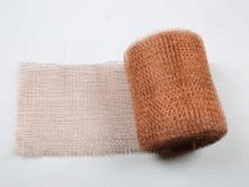
To function, e-skin devices require intricate networks of flexible electrodes and interconnects, essentially the ‘nerves’ of these artificial skins. Recent advances leverage conductive inks, silver nanowires, carbon nanotubes, fine copper tapes, and even stretchable conducting fabrics to form durable, flexible circuits that can survive bending and stretching in real-world environments. Fabrication techniques such as screen printing, inkjet printing, heat lamination, and the manual layering of conductive tapes or fabrics enable versatile prototyping and scalable production.
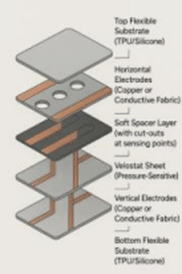
The typical e-skin build consists of a multi-layered structure. At the very bottom is a flexible electrode layer, often composed of TPU or silicone, loaded with horizontal conducting traces laid from copper tape or printed ink. In more advanced builds, a mesh, porous foam, or ethylene-vinyl acetate (EVA) spacer layer is used above the electrode. This layer reduces false positives and ensures that only direct pressure at specific points establishes electrical contact.
Above this sits the all-important Velostat layer, providing the piezoresistive touch-sensitivity core of many modern e-skin devices. A second electrode layer, oriented vertically to the lower grid, is positioned atop the Velostat. The intersection points between horizontal and vertical traces form a matrix or array of ‘pixels’, each capable of reporting pressure or touch individually. An ultra-thin encapsulation film, usually another stretchable polymer such as TPU, is laminated to protect the entire assembly from humidity, dust, and mechanical abrasion, while still retaining flexibility and comfort for wearers or integration into robotic or prosthetic devices.
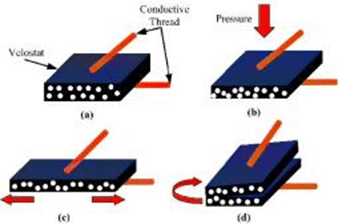
Crafting these layers into a single functional sheet involves precise alignment, which can be achieved with laser-cut templates, computer-aided design (CAD) patterns, or hands-on prototyping. Clean and seamless builds are best achieved with heat lamination (for TPU-based systems) or soft adhesives such as silicone glue and double-sided medical tape.
Power, connectivity and calibration
For modularity and ease of connectivity, flat, flexible cables, conductive threads, or friction-fit header pins are attached to the edges of the electrode grids, providing accessible electrical interfaces for connection to control electronics such as microcontrollers. Once assembled, e-skin systems undergo electrical testing and calibration.
A microcontroller will sweep matrix rows and columns to record voltage changes when pressure is applied to the skin. This data, calibrated using reference forces, is translated into an accurate map of pressure or touch in real time, providing immediate, actionable feedback for robotics, prosthetic control, or biomedical monitoring. Power management and data communication are core design considerations for wearable and embedded e-skin.
These systems may use miniaturised batteries, flexible solar cells for renewable power, or energy harvested directly from human motion via the triboelectric or piezoelectric effect. Wireless communication modules, such as Bluetooth Low Energy (BLE) or Near Field Communication (NFC) chips, allow seamless integration with smartphones, computers, or robotic control systems for data analysis, health tracking, or adaptive robotic behaviour.
The race towards self-powered e-skin is a major research frontier, aiming to develop systems that operate indefinitely without external batteries, making them ideal for continuous monitoring or autonomous robotic deployment.
Transforming robotics and healthcare
The transformative applications of e-skin are far-reaching and continue to expand rapidly. In robotics, e-skin provides a layer of real-time sensory feedback that grants robots the fine motor control essential for handling delicate or complex objects. With e-skin, robots can precisely modulate their gripping force to avoid breaking fragile glass, identify objects’ surface textures, including reading Braille-like bumps, or even sense gestures or emotional cues for more natural human-robot interaction. Pioneering research at Seoul National University, for example, has used ultra-high-resolution e-skin on robotic fingertips to distinguish Braille dots, setting new benchmarks in sensitivity and functional dexterity.
Healthcare is another area witnessing dramatic changes due to e-skin innovation. Integrated into smart insoles worn by diabetic patients, e-skin continuously monitors pressure and temperature distribution across the foot, alerting wearers or clinicians at the earliest sign of abnormal patterns that could lead to dangerous ulcers. Such smart monitoring enables pre-emptive care, significantly reducing the risk of infection, tissue damage, or amputation. Similarly, e-skin built into mobility aids or braces enables clinicians to closely monitor posture, joint movement, or gait, enabling real-time fall-prevention strategies for older people or those with neurological disorders.
Wearable e-skin ‘tattoos’, ultra-thin sensor patches that adhere unobtrusively to the body, are enabling continuous, comfortable monitoring of vital signs, cardiac rhythms, or hormone fluctuations, heralding a new era in digital medical diagnostics.

Giving prosthetics the sense of touch
In prosthetics, e-skin bridges one of the most significant remaining gaps for amputees: the absence of tactile feedback. Advanced prosthetic limbs fitted with e-skin can now detect the force and location of contact, giving users direct haptic feedback via actuators or, through advanced neural interfacing, stimulating nerves to elicit the conscious sensation of pressure, temperature, or even pain. Such feedback dramatically improves user confidence, grip control, and the sense of prosthetic embodiment.
In a landmark demonstration, the Johns Hopkins University ‘e-dermis’ project incorporated e-skin into a prosthetic hand that could sense and transmit pressure and pain cues to the user’s nerves, closing the loop between the artificial limb and the nervous system.
Soft robotics, robots made of flexible, deformable materials, benefit from e-skin by gaining the touch sensitivity necessary to handle fragile or unstructured objects, which is vital for fields such as agriculture, food handling, disaster search, or minimally invasive surgery. E-skin is also enhancing gesture-based interfaces, permitting users to control machines or computers via subtle changes in finger or skin position, picked up by sensors discreetly integrated into clothing or wearable bands.
This trend towards integrating human-like perception into electronics underscores a wider movement towards human-centred, embodied technology, a blurring of the division between humans and machines.
Towards human-centred technology
With e-skin, distinctions begin to fade; electronics no longer simply sit on the skin, but become one with the body, matching its flexibility, adaptability, and reactivity. Educators, technologists, and makers around the world can now, with accessible materials like Velostat, conducting tapes, and some creativity, prototype and iterate responsive electronic skin systems for research, teaching, and custom healthcare solutions.
The use of minimal, cost-effective materials for e-skin, such as Velostat and TPU, gives it both technical and economic advantages, allowing widespread adoption and innovation at all levels. In the laboratory, precise, high-density sensor arrays can be rapidly prototyped using printed electronics and flexible substrates. In the clinic and at home, affordable builds offer hope for individualised healthcare solutions.
The road ahead
Future developments are focusing on materials that can heal themselves after damage, just like human skin, and biodegradable construction for temporary medical monitoring or post-surgical care, minimising electronic waste.
The integration of artificial intelligence directly onto e-skin chips is enabling localised interpretation of complex touch patterns, bringing distributed sensory intelligence directly to the surface of devices and limbs. Additive manufacturing, including 3D printing of e-skin, is democratising production, enabling personalised, sensor-rich wearables and prosthetics at ever-lower cost.
Analysts predict that by 2030, the global e-skin market will grow to $10 billion, driven by the expanding demand for flexible sensors in healthcare, eldercare, robotics, defence, and consumer wearable technology.
Challenges and future outlook
Despite its promise, e-skin faces critical challenges: balancing battery life and flexibility, ensuring component durability under real-world conditions, scaling up manufacturing from laboratory prototypes to mass production, refining the interface between skin and electronics, and addressing the security and privacy challenges that come with always-on, body-worn, data-gathering sensors in medical and everyday applications.
Electronic skin stands today as a landmark convergence of biology and digital technology, embodying the idea that devices will no longer be merely worn or held, but truly experienced as an extension of our own capabilities. What was once the dream of science fiction, a touch-sensitive, adaptive, and intelligent artificial skin, has become the centrepiece of a new era in human-machine integration.
The future belongs to those who can blend innovative materials, practical engineering, and visionary design to create systems that are not just tools but partners in our daily experience.
The simplest components, Velostat sheets, flexible substrates, microcontrollers, and a spark of creativity, now open the frontier to custom e-skin solutions that sense, act, and heal alongside us.
Practical applications in prosthetics, robotics, healthcare monitoring, and wearable technology are only the starting point. As development continues, e-skin will define the next wave of human-technology symbiosis, where digital and biological systems are not merely connected but inseparable. In this bio-digital frontier, e-skin will not just change the machines we build, but transform the very nature of how we sense and interact with our world.