An AI system remembers information for longer while using less power and memory, helping robots, wearables, and sensor networks process data more efficiently.
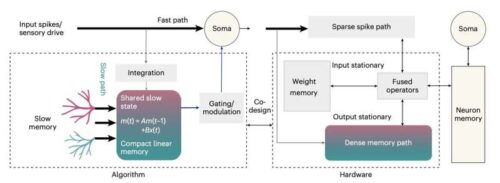
Researchers from Imperial College London in the United Kingdom and ETH Zurich in Switzerland have developed a new spiking neural network (SNN) architecture that improves the way AI systems retain information over long periods while reducing energy use and memory requirements. The system combines a brain-inspired dual-memory design with specialized hardware to handle long-sequence tasks more efficiently.
In tests, the architecture delivered more than four times higher throughput and over five times better energy efficiency than existing implementations. The researchers also reported that it achieved competitive performance while using 40–60% fewer parameters than comparable spiking neural networks.
Spiking neural networks are AI models inspired by biological neurons. Unlike conventional AI models that process information continuously, SNNs operate through brief signals called spikes, allowing computation only when meaningful changes occur. This event-driven approach can lower power consumption, making SNNs attractive for energy-constrained applications. However, previous SNNs have struggled to maintain task-relevant information over extended periods, particularly when memory and energy resources are limited.
To address this challenge, the researchers designed a dual-memory pathway architecture inspired by the brain’s fast and slow neural processes. The software combines fast spiking activity with a dedicated slow-memory pathway that stores a compact summary of recent activity. This enables the network to retain important context over longer timescales while preserving the efficiency of event-driven computation.
The team also developed a near-memory-compute hardware architecture tailored to the network design. The hardware keeps compact memory states close to processing elements, reducing data movement and improving efficiency across both sparse spiking operations and memory-intensive tasks.
According to the researchers, the combination of algorithm and hardware design provides a scalable framework for real-time neuromorphic computing. Potential applications include robotics, wearable devices, edge AI systems, and connected sensor networks that require continuous data processing under tight energy constraints.