




Can a simpler transmission make hybrid vehicles lighter, cheaper and more efficient? Faraday Future believes its newly patented drivetrain could reshape extended-range electric mobility.
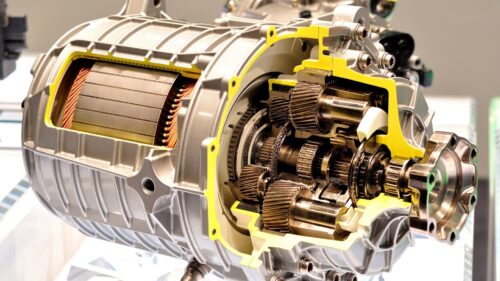
Faraday Future has unveiled a patented hybrid transmission architecture designed to simplify vehicle powertrains while improving efficiency, flexibility and driving performance. The newly granted US Patent No. 12,630,004, covering a Range-Extending Hybrid Transmission System, introduces a drivetrain that separates the functions of the internal combustion engine, generator-motor and drive wheels instead of mechanically linking them through a conventional transmission.
Traditional hybrid vehicles rely on complex arrangements of gears, shafts, motors and clutches to combine petrol and electric power. According to Faraday Future, this complexity can increase vehicle weight, manufacturing costs and engineering challenges while limiting operational flexibility.
The patented design adopts a different approach by allowing the engine, electric generator-motor and drive wheels to operate independently or together, depending on driving conditions. Multiple shafts, clutches and a differential manage power flow, enabling the engine to generate electricity, assist with propulsion or work alongside the electric motor without remaining permanently connected to the wheels.
The company says this architecture allows all available power sources to contribute simultaneously when maximum performance is required, while enabling individual components to operate independently to prioritise energy efficiency. Faraday Future describes this concept as delivering “strong range extension with weak hybridisation”, aiming to extend driving range without the complexity associated with many conventional hybrid systems.
The transmission patent is expected to become part of the company’s AIHER (AI Hybrid Extended-Range Electric Powertrain) platform, introduced in 2025. If successfully commercialised, the simplified architecture could reduce manufacturing complexity, improve system reliability and lower production costs while enhancing vehicle acceleration and overall performance. The company also believes the technology could prove particularly valuable in colder climates, where battery efficiency typically declines and supplementary range becomes increasingly important.
However, the technology remains at the patent stage and has not yet been validated in production vehicles. Real-world testing, durability assessments and cost evaluations will determine whether the concept can deliver its promised advantages. Faraday Future intends to incorporate the transmission into future AIHER-powered models, including proposed versions of its Super One vehicle, supporting the growing market for extended-range electric vehicles (EREVs).
