




MIT researchers have developed a low-power scanning reflectarray antenna that improves anti-jamming satellite communications while reducing size, weight and energy consumption for low-Earth orbit satellite networks.
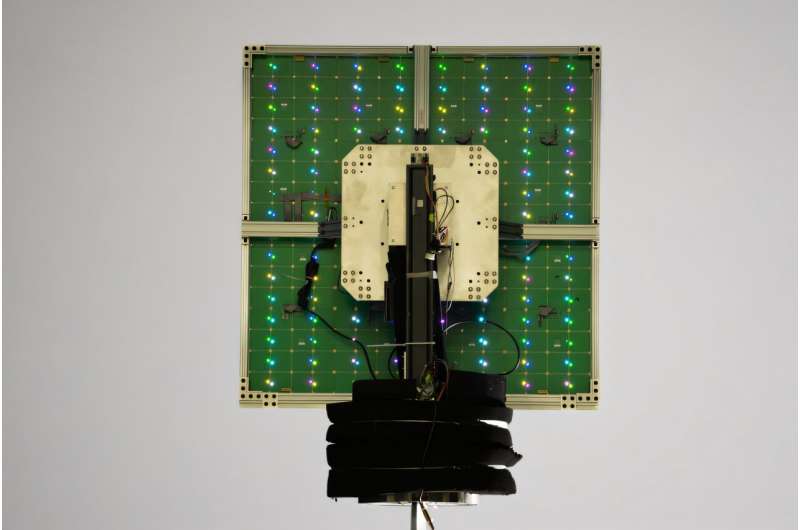
A research team at MIT Lincoln Laboratory has developed a scanning reflectarray antenna designed to enhance tactical satellite communications in low Earth orbit (LEO) while significantly reducing size, weight, power, and cost (SWaP-C). The prototype targets secure communications in contested environments where signal jamming and electronic interference pose growing challenges for military satellite networks.
The antenna, called Hosted Nimble Beamforming Anti-Jam Reflectarray (HoNi BAJR), uses individually controlled reflective elements to shape and steer communication beams electronically. Unlike conventional phased-array antennas, which require a dedicated amplifier for every antenna element, the reflectarray architecture redirects signals from a single feed antenna. This simpler design reduces hardware complexity while maintaining adaptive beamforming capabilities needed to counter jamming attempts.
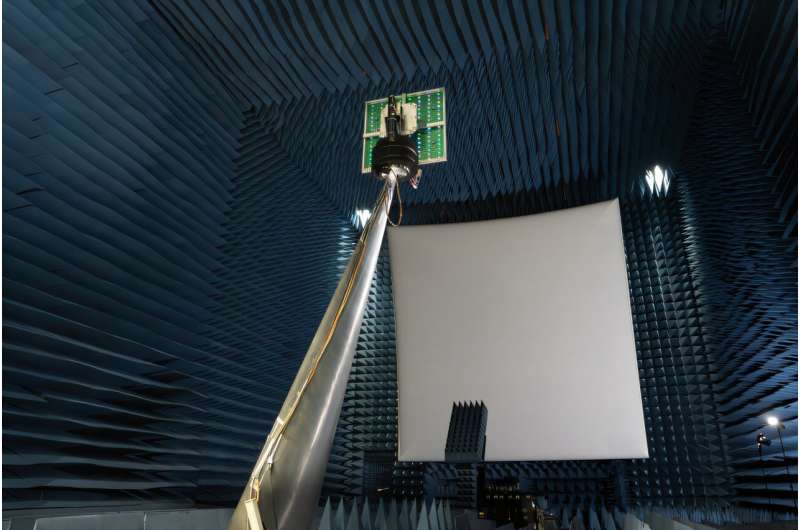
Adaptive beamforming enables the antenna to alter its radiation pattern in real time, placing signal nulls toward interference sources while maintaining reliable links with ground users. Such capabilities are becoming increasingly important for proliferated low-Earth orbit constellations, where satellites must remain compact, energy efficient and resilient against electronic attacks without sacrificing communications performance.
According to the research team, the reflectarray architecture reduces power consumption by approximately 95% compared with traditional phased-array systems because it eliminates the need for amplifiers across every antenna element. The modular approach also improves scalability, allowing engineers to expand or shrink the antenna array without redesigning complex beamforming networks for each configuration.
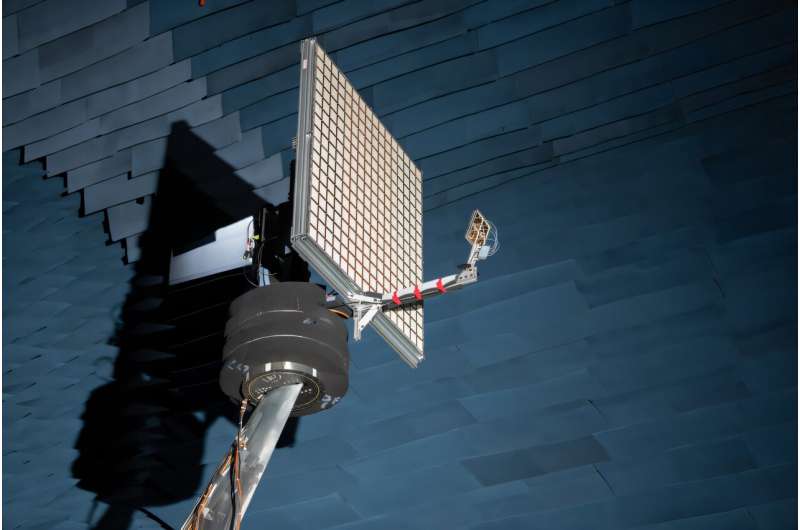
The prototype incorporates 256 individually controlled reflective elements and has been designed to fit within the physical constraints of small-satellite platforms. Laboratory testing demonstrated high scan angles, allowing the antenna to communicate across a broad field of view. Researchers also showed that the system could generate multiple simultaneous beams with minimal signal degradation, enabling communications with multiple users without significant information loss.
The technology could support next-generation protected tactical satellite communications as governments and defense agencies deploy larger LEO constellations requiring secure, anti-jam connectivity. By combining adaptive beam steering with lower power requirements and reduced system complexity, the reflectarray design offers a potential alternative to conventional phased-array antennas for future satellite communication platforms operating in challenging electronic warfare environments.


