




A hybrid energy storage system combining batteries and ultracapacitors has entered field testing for applications including AI data centres and high-performance computing.
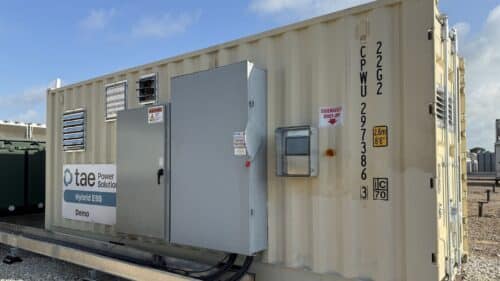
UK-based TAE Power Solutions has delivered its first prototype of a hybrid energy storage system to MARA Holdings in the US. for testing in the field. The hybrid system integrates batteries, ultracapacitors, and intelligent control systems to manage continuous power demand and sudden power surges, focusing on applications like crypto mining and AI data centers.
This is the first real-world deployment of TAE’s fusion-derived hybrid energy storage architecture. As per TAE, this hybrid system is intended to safeguard batteries against rapid power surges.
“Shipping our first hybrid energy storage prototype to MARA is an important step in our collaboration to move this technology from development into a real-world operating environment,” said Francisco Garcia, General Manager, Stationary Energy Storage at TAE Power Solutions.
MARA Holdings operates large bitcoin mining facilities that require substantial and highly variable amounts of power. Conventional lithium-ion batteries struggle to handle sudden power spikes, making hybrid storage systems potentially useful for such applications.
In this type of system, ultracapacitors absorb and discharge rapid power surges, while batteries provide steady power. Ultracapacitors have a much greater capacity to undergo many charge-discharge cycles compared to batteries, and protect batteries from cyclic loads.
For TAE, this deployment serves as a field test that could demonstrate the technology’s suitability for AI data centres, where growing compute demands are straining power infrastructure.
“MARA’s operating profile gives us a valuable opportunity to validate performance, collect field data, and refine the system ahead of future production deployments. It is exactly the type of demanding power environment where hybrid storage can demonstrate its value,” Garcia added.
“As an integrated system, the hybrid platform is designed to support both short-duration power events and sustained energy needs in demanding applications such as high-performance computing and AI data centers,” the company stated.
TAE and MARA expect to complete testing soon, with additional full-scale production deployments planned for later this year.

