




What if satellites could think before they transmit? A home-built spacecraft is preparing to prove that AI can process data in orbit, cutting reliance on powerful computers back on Earth.
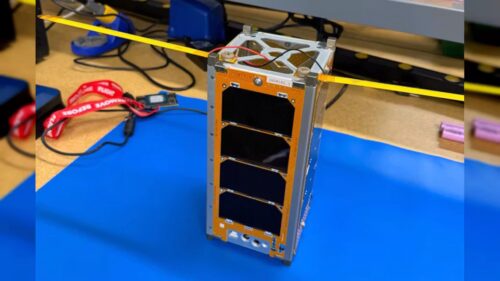
A home-built 2U CubeSat is preparing for launch with a mission that could demonstrate a new approach to space-based artificial intelligence. Instead of simply collecting data and transmitting it to Earth for processing, the satellite is designed to perform AI inference directly in orbit using onboard computing hardware.
The spacecraft has been developed in a home laboratory rather than a dedicated aerospace facility. At the heart of the mission is an AI payload powered by an NVIDIA Jetson Orin Nano, running a quantised TinyLlama large language model. By processing information in space, the system aims to reduce the need to send large volumes of raw data to ground stations, potentially improving efficiency for future satellite missions.
Operating advanced AI hardware in orbit presents several engineering challenges. Power is severely limited, there is no atmosphere to provide conventional cooling, and any software failure could leave the satellite permanently inoperable. To address these constraints, the spacecraft includes an always-on flight computer that activates the AI module only during scheduled operating windows. Once the AI task is complete, the system powers down again to conserve battery life.
Supporting the AI payload is a collection of custom-designed subsystems, including electrical power, radio and antenna deployment boards. The power architecture incorporates watchdog circuitry capable of recovering from faults, while mission-critical functions such as antenna deployment and AI processing are implemented as fault-tolerant state machines designed to withstand unexpected resets and power interruptions.
After onboard processing is complete, the results are transmitted to Earth through a custom-built 437.08 MHz UHF radio link using AX.25 packet communications. In keeping with amateur satellite practices, the telemetry is intentionally left unencrypted, allowing radio enthusiasts worldwide to receive, decode and monitor transmissions using their own ground stations.
The project’s creator has also released the complete engineering work as open source. The publicly available resources include flight software, AI payload code, software-defined radio tools, RF design files, KiCad schematics, PCB layouts and extensive documentation covering system architecture, hardware development and thermal analysis. While enthusiasts can reproduce the satellite’s design, launching a copy into orbit would still require access to a suitable rocket launch opportunity.


