

A tandem solar cell combining CIGS and perovskite semiconductors has set a new efficiency record, demonstrating the potential of next-generation solar technologies.
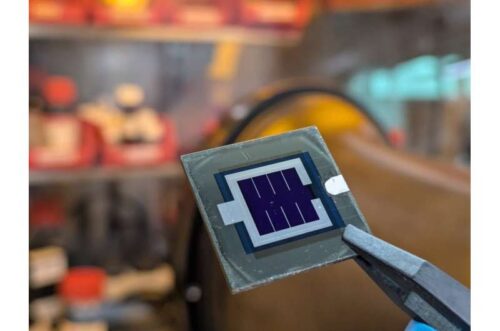
An international research team led by researchers from HZB and Center for the Science of Materials Berlin (CSMB) at Humboldt University in Berlin, has created a tandem solar cell whose power conversion efficiency has been measured and certified to be 25.5 per cent, thus establishing a new world record for a CIGS-perovskite solar cell. The previous record for this combination of materials and cell size stood at 24.6 per cent.
In this tandem cell, the layer of a CIGS semiconductor is combined with perovskite and some optimized intermediate layers. The record has been certified and added to the Solar Cell Efficiency Tables, published in the journal Joule. For inclusion in the record tables, solar cells must achieve high efficiencies and have an active area of more than 1 cm².
“To push past our previous milestone within the framework of the European project SOLMATES, we employed CIGSe bottom cells with different band gaps (i.e. 1.05 eV and 1.1 eV) and two different thicknesses of aluminium-doped zinc oxides with similar characteristics. We also tested different cell architectures, in addition to the continuous improvements we had achieved with our previous record,” says Dr. Guillermo Farias Basulto.
In order to minimize the losses due to interfacial recombination and enhance the device stability, Chemist Wuai Zhang screened multiple combinations of nickel oxide (NiOx) and self-assembled monolayers (SAMs) as hole transport materials. The electron-selective contact processing was refined by controlling the initial thermal evaporation rate of C60 on a 1 nm-thick LiF passivation layer.
The cell area of the record device is 1.081 cm². The same material stack has been used to fabricate a 2.25 cm² mini-module with an efficiency of 19.7 per cent.
“The physics embedded in our current cell architecture suggests that 25.5 per cent is merely a steppingstone, given that our in-house testing of similar architectures has already reached efficiencies of 27.5 per cent,” Farias Basulto points out.