

AI and machine learning enable faster and more accurate arc fault detection for AC and DC applications, accelerating the development of intelligent safety systems.
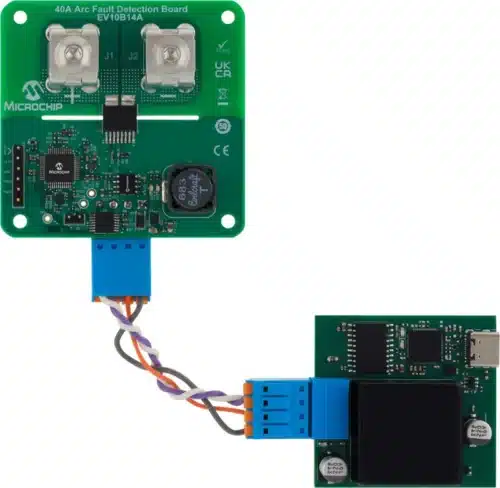
The reference architecture from Microchip presents a model for an arc fault detection system using machine learning that utilises real-time digital signal processing along with edge AI in order to provide faster, more accurate, and reliable arc fault detection. The platform aims to help developers accelerate the development of machine-learning-based arc fault detection systems in applications including solar PV, EV charging, smart ignition, and industrial safety.
An electrical arc fault is one of the main reasons behind the occurrence of fires in residential, commercial, and industrial settings. Such arc faults are often caused by faulty wires or connections. Current methods used to detect arc faults are based on thresholds and rules which make it hard to distinguish between a fault and electrical noise.
The system design utilises a platform that contains a digital signal controller that includes a CPU clocked at 200MHz, an advanced DSP engine with optimised DSP libraries and hardware floating point unit for real-time ML inferencing operations. As per the company, the ML models that have been trained through real world data can achieve up to 98 per cent arc fault classification accuracy with significantly reduced false positives compared with traditional methods.
This solution enables AC/DC arc fault detection that caters to a wide variety of use cases such as solar photovoltaic, microinverter, EV charging stations, automotive ignition system, and data centers. The scalable hardware system is capable of operating on different voltage ranges from 120 V to 400 V AC and 48 V to 1000 V DC and current of up to 100 A.
The design also includes high-speed 40Msps analogue-to-digital converters (ADCs) for real-time data acquisition. Furthermore, there are tightly coupled peripherals integrated with the processor to lower the latency in the process of sensing, processing and detection of arcs. High-speed DSP core implements single cycle multi-operation MAC instructions to increase the performance in ML inferencing, while optimised DSP library is supposed to minimise the time required to develop applications.
In order to assist with the development of products based on the reference design, there are provided schematics, printed circuit board (PCB) files, bill of material (BOM), optimised DSP libraries, demo code and a detailed user guide.
For more information, click here.