





A motion sensing technology detects smaller movements from longer distances, helping control lighting, security, heating, cooling, and energy use in buildings.
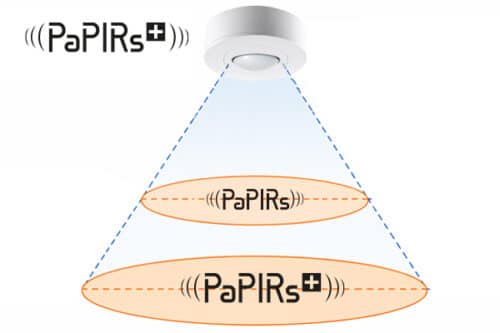
Panasonic Industry Europe has expanded its PIR motion sensing portfolio with PaPIRs+, a new generation of its PaPIRs technology for building automation and smart infrastructure. The new technology is designed to improve motion detection while keeping the simple design and reliability of traditional PIR sensors.

PaPIRs+ uses redesigned pyroelectric sensing elements with larger and improved sensing structures. These changes increase infrared absorption and provide up to twice the sensitivity of earlier PaPIRs sensors. As a result, the technology can detect smaller movements over longer distances and wider areas while reducing blind spots.
The technology is aimed at building automation designers, system integrators, and equipment manufacturers developing smart lighting, HVAC, security, and energy management systems. They can use PaPIRs+ to build systems that detect occupancy more accurately, automate lighting and climate control, improve energy efficiency, and enhance user comfort without significantly increasing system costs.
The higher detection performance also makes PaPIRs+ suitable for applications such as lighting control, HVAC systems, and smart building solutions, where accurate motion sensing is important. Despite the performance improvement, the technology is designed to keep system costs almost unchanged.
“PaPIRs+ is not intended to replace our proven PaPIRs technology. It is designed to extend it,” explains Robert Spiegler, Lead Product Manager at Panasonic in Ottobrunn, Germany. “Conventional PaPIRs sensors continue to be an excellent choice for standard applications where reliable motion detection is required. With PaPIRs+, we provide an additional high-performance option for customers who need enhanced sensitivity, wider coverage, or more demanding detection capabilities.
The portfolio also includes the recently introduced Flat Wide Detection Type, which features an ultra-flat lens and a wide detection area. The design allows the sensors to blend into offices, schools, homes, and other space-limited environments while providing broad motion coverage.


