


A fabric switch handles data transfer between AI chips, reduces GPU workload, and helps AI systems process data faster during inference.
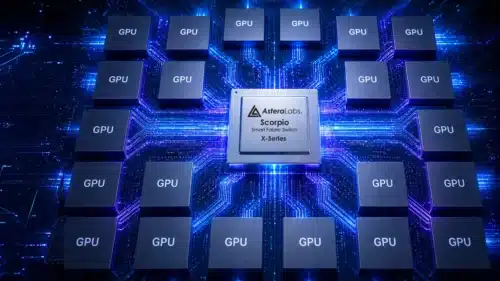
Astera Labs has launched the Scorpio X-Series 320 Lane Smart Fabric Switch, a memory-semantic fabric switch designed for large AI clusters. The switch is now shipping to leading hyperscalers and includes two built-in hardware engines—Hypercast and In-Network Compute—to reduce communication overhead during AI inference. The company says the switch can lower GPU I/O by up to 49% for collective operations by moving some communication tasks from GPUs to the switch itself.
The Scorpio X-Series is designed for AI models that use mixture-of-experts (MoE) architectures, where data must be exchanged frequently between multiple accelerators. Hypercast accelerates communication tasks such as AllGather, AllScatter, and All-to-All by handling data replication inside the switch. The In-Network Compute engine performs AllReduce and ReduceScatter operations directly in the switch, allowing GPUs to spend more time processing AI workloads instead of managing data movement.
Alongside the X-Series, Astera Labs expanded its Scorpio P-Series PCIe 6 fabric switch family to support configurations from 32 to 320 lanes. This gives server and data center designers more options for building AI systems of different sizes using PCIe-based accelerator platforms.
According to Astera Labs CEO Jitendra Mohan, the Scorpio X-Series replaces multiple legacy switches with a single high-radix switch, enabling larger AI clusters to communicate in a single network hop while reducing latency.
The switch uses open PCIe and memory-semantic connectivity instead of proprietary interconnects, allowing it to work with different accelerator platforms. Memory-semantic connectivity enables accelerators to access shared resources through the fabric in a way similar to local memory, reducing software overhead.
Astera Labs also said its COSMOS software platform supports monitoring, protocol analysis, and fault detection across switches, retimers, optical links, and copper connectivity. The software is intended to simplify deployment and management of AI infrastructure as data centers adopt a wider range of accelerators and cluster configurations.