





An edge AI chip supports different systems and is designed for industrial, automotive, aerospace, defense, and wearable applications.
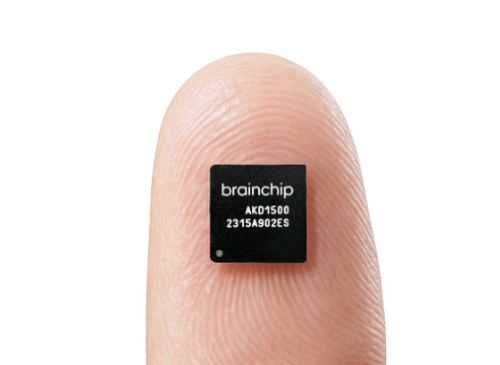
BrainChip has announced the commercial availability and initial production shipments of its Akida AKD1500 reference chip, designed to deliver event-based AI processing at the edge with sub-watt power consumption. Manufactured by GlobalFoundries (GF) using its 22nm Fully Depleted Silicon-on-Insulator (22FDX) process, the production-ready chip is built for continuous AI inference directly on edge devices.
The AKD1500 can operate as either a standalone processor or a hardware co-processor. Unlike conventional AI accelerators that remain continuously active, it processes data only when events occur, reducing unnecessary power consumption. According to BrainChip, the chip delivers near-terra operations-per-second (TOPS)-scale efficiency while consuming less than 300mW in PCIe mode and under 200mW in serial mode, helping remove power and thermal limitations in edge AI deployments.
Production-volume shipments have already started, with multiple customers receiving the AKD1500 for defense and wearable applications. To support deployment in demanding environments, the device will undergo qualification testing across multiple thermal and environmental screening levels specified by customers.
The AKD1500 is being qualified in two hardware formats to meet different system design requirements. The packaged silicon version is intended for standard form-factor, high-reliability circuit boards, while the bare die version is designed for direct-to-substrate integration in space-constrained products and custom multi-chip modules.
These hardware options, together with the environmental screening process, are intended to enable sovereign, cloud-independent AI execution in applications operating under severe shock, vibration, and temperature conditions. Target applications include industrial IoT, automotive, aerospace, and defense systems.
The chip has also been designed with a dual-interface architecture to support a wide range of edge computing platforms. Its PCIe interface allows the AKD1500 to function as a high-speed AI offload engine alongside x86, Arm, and RISC-V application processors in high-performance edge systems. It also supports serial interfaces optimized for low-end, battery-powered embedded devices, bringing advanced pattern recognition and on-device learning capabilities to low-cost microcontrollers without requiring a complete system redesign.
Click here for the original announcement.

