


A new board-mounted power factor correction module packs 1100W into a half-brick footprint, combining high efficiency, digital management and integrated protection for space-constrained industrial, medical, defence and telecom power systems.
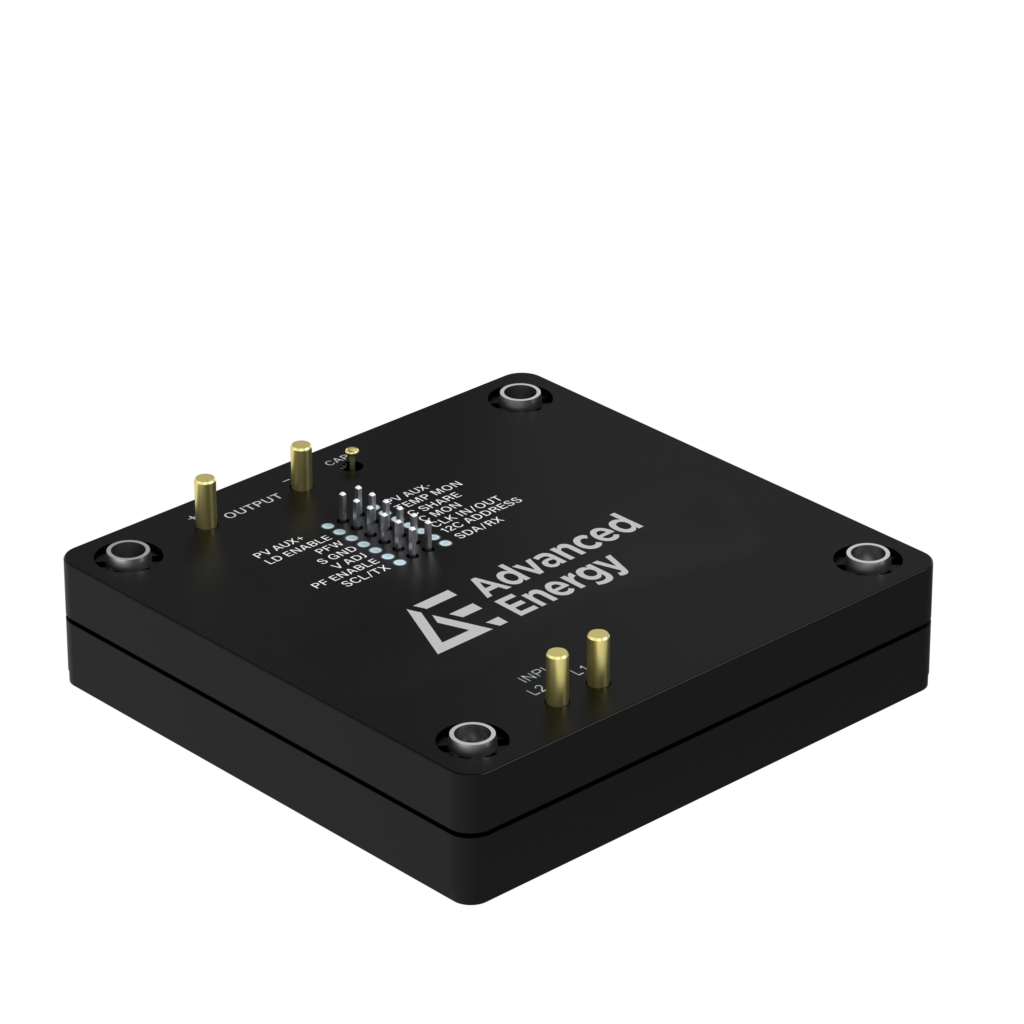
Advanced Energy has introduced the AIH03ZPFC, a 1100W board-mounted power factor correction (PFC) module that brings high-power AC-DC front-end conversion into a standard half-brick form factor. Designed for compact power architectures, the module targets industrial automation, medical equipment, defence electronics and telecommunications systems where board space, efficiency and thermal management are major design priorities.
It delivers a regulated, non-isolated 390V DC output while operating from a universal 85V to 264V AC input. According to the company, it achieves 97.3% peak efficiency, improving efficiency by 2.3 percentage points over its previous-generation PFC modules. The higher efficiency also translates into lower energy losses, helping designers improve overall system performance while reducing heat generation.
The key features are:
- 44% higher power density reaching 380W/in³
- Internal inrush current limiting
- Digital PMBus control and monitoring
- Auxiliary housekeeping power output
- Standard 61 × 58.4 × 13.3mm half-brick package
A key differentiator is its ability to deliver 1100W in a compact half-brick package. The module increases power density to 380W/in³, representing a 44% improvement compared to earlier designs. This enables designers to reduce power supply size without compromising output capability.
Unlike conventional half-brick PFC modules,it integrates digital PMBus control and monitoring with internal inrush current limiting, reducing the need for external circuitry. The integrated architecture simplifies power system design while providing improved visibility into operating parameters and system health.
The module can function as a standalone power factor correction stage or be paired with downstream DC-DC converters in distributed power architectures. It also provides auxiliary power for housekeeping functions, enabling further reduction in external components and supporting more compact system implementations.
For thermal management, it uses baseplate contact cooling and supports operation from −20°C to +100°C, with startup capability down to −40°C. It is compatible with standard heatsinks and existing thermal solutions, making integration easier in high-density power systems.
By combining high output power, digital management, integrated protection and a compact mechanical footprint, it offers designers a space-efficient front-end power solution for next-generation electronic equipment requiring high efficiency, high power density and simplified system integration.