

From building India’s first open quantum hardware ecosystem to assembling a working quantum computer in just four months, Qbit Force is redefining how deep tech is built and made accessible. In an exclusive conversation, L. Venkata Subramaniam, CEO of Qbit Force, speaks with EFY’s Saba Aafreen about why the real bottleneck in quantum is not ideas or software but hardware, and how opening up the system could reshape India’s position in the global quantum race.
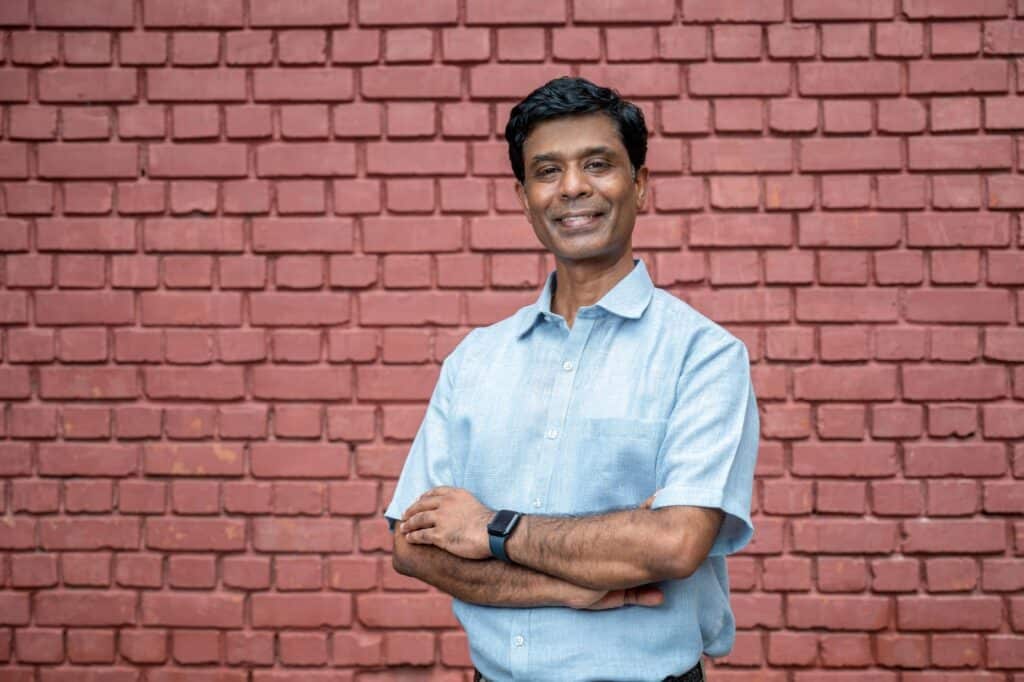
Q. In simple terms, how would you describe Qbit Force?
A. At a simple level, Qbit Force is building an open-access hardware company for quantum computing, inspired by the open source software model, where anyone can contribute. The idea is to let people come in and build components depending on what they want to work on. The larger goal is to simplify quantum hardware, which today feels complex mainly because it is not visible or accessible. By opening up the system and allowing direct engagement, we aim to make quantum computing more visible, understandable, and open to build on.
Q. What is a quantum computer, and how is it different from a normal computer?
A. All computers today, from phones to supercomputers, work on bits, zeros and ones, and every computation is ultimately reduced to these binary states, even images and interactions. Quantum computing shifts this model from bits to qubits. A qubit is not limited to zero or one; it can exist in multiple states at once and can also interact and share information with other qubits, making it a fundamentally different system rather than an extension of classical computing.

With this shift, we can model problems in a way that more closely reflects how nature actually behaves, rather than forcing everything into binary form. This has major implications for areas like drug discovery and AI, where more natural representations improve understanding and inference. At the same time, classical computers will not disappear. The future is likely a hybrid system in which CPUs, GPUs, and quantum processors work together, each handling what it is best suited for.
Q. What gap in India’s quantum ecosystem led to the creation of Qbit Force?
A. The biggest gap we saw in India’s quantum ecosystem was the lack of hardware. Most work is software-focused, which has shaped how people think about quantum computing, mainly in terms of algorithms and access, rather than the actual systems that enable it. But if you want real products and control over the supply chain, hardware has to be built alongside software. In global industries like smartphones, a few countries dominate the full stack, while India contributes but is not part of the core. We wanted to change that by building an open hardware ecosystem where the system is visible and understandable, because once that happens, even complex components become approachable. Even basics like thermometers were not being built locally due to a lack of engagement, but that is now starting to change as people move from learning to actually building.
Q. What early milestones validated your direction for Qbit Force?
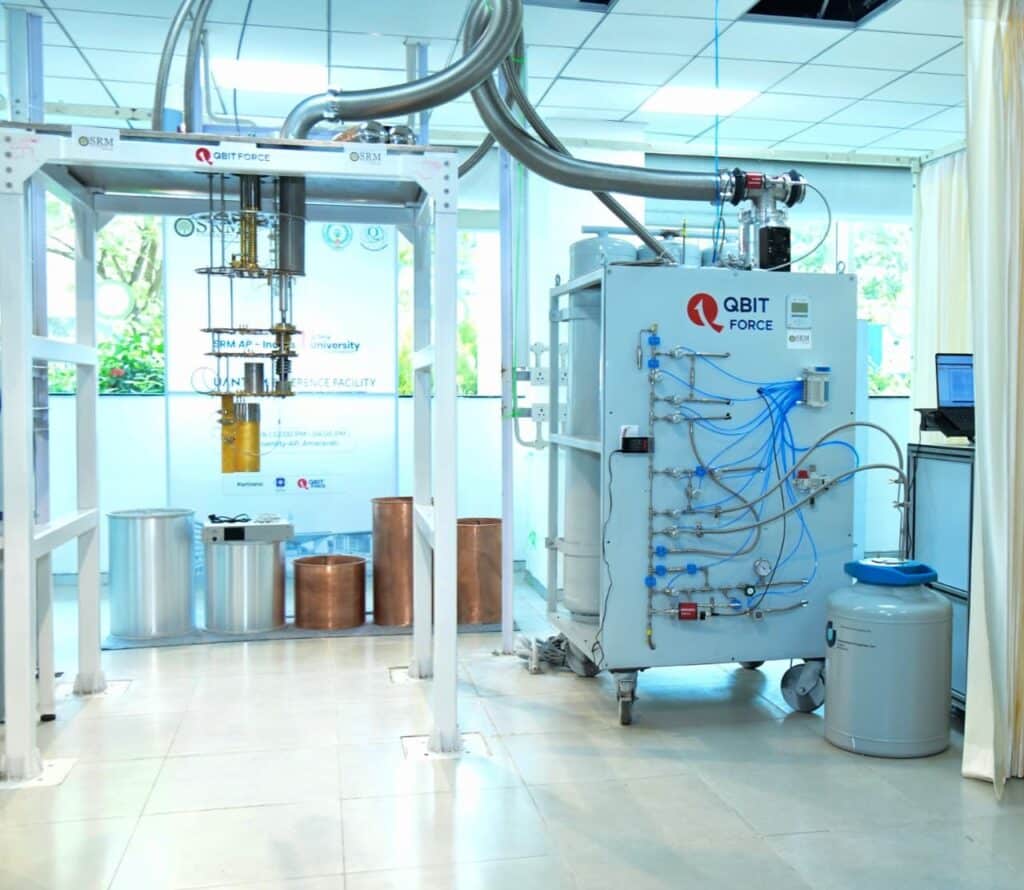
A. We incorporated on December 15, 2025 and set a clear goal to build a quantum computer by April 14, 2026, World Quantum Day, a target many were sceptical about since several components had never been built in India. In just four months, we designed, sourced, and assembled a system comprising around 150 components, managing everything from core technology to logistics and infrastructure, which itself served as strong validation. But the bigger milestone was the ecosystem that came together, with teams from DRDO, Indian Institute of Science, Tata Institute of Fundamental Research, IIT Bombay, and IUAC Delhi collaborating alongside young talent, showing that with openness and shared effort, even highly complex systems can be built much faster than expected.
Q. What is your core approach to building a superconducting qubit system?
A. The core of our approach is the qubit itself, which is fundamentally different from classical bits as it can exist in multiple states at once and share information with other qubits. While there are several ways to build qubits, including atoms and photons, we chose the superconducting route, which requires extremely low temperatures and led us to build a dilution refrigerator in India for the first time rather than importing one, giving us direct control over and understanding of the system as it evolves.
Beyond that, the system depends on several tightly integrated components, such as cryogenic wiring and highly precise control electronics that drive the qubit, where even small voltage variations are unacceptable. Bringing all of this together is complex and not well documented, which is why such systems are usually built behind closed doors. In our case, we have done it openly so people can see, understand, and build on top of it.
Q. What is your current business model, and who are your primary users?
A. We are building quantum computers and dilution refrigerators, and we are already seeing interest from multiple buyers. Our model is to continuously improve the system, build as many components as possible within India, source the rest from the ecosystem, and integrate everything into a complete machine. It is a made-to-order approach in which users specify the configuration, components, and capabilities they need, and we build systems accordingly. The architecture is modular, so it can be upgraded over time based on budget, research needs, and usage, rather than being a fixed product. Our primary users include universities, government labs, researchers, and emerging startups, each with different requirements, so we tailor systems to their specific focus areas, whether cryogenics, fabrication, or processors, and this is evolving as new use cases emerge.
Q. Could you walk us through the Amaravati testbeds 1Q and 1S?
A. Both systems are similar at this stage and use the same core components built by teams including Vijay Raghavan, Vibhor Singh, Deepti Gupta, and Sugam Kumar, but they are evolving differently based on where they are deployed. The 1S system at SRM University has naturally become a research and education-driven testbed, with active participation from students, faculty, and researchers. Even complex challenges like sourcing 50 nm silver nanoparticles, which are difficult globally, are being taken up locally as research problems, showing how the system is already functioning as a hands-on platform for solving real scientific and engineering challenges.
Q. What kind of applications can currently be run on these testbeds?
A. Right now, these testbeds are primarily being used for hardware testing, where anyone building components like thermometers, processors, or amplifiers can come and test them, something that was not possible in India earlier. Earlier, researchers had to rely on a few global facilities, such as those in the Netherlands, which are expensive, have long waitlists, and often prioritise local users. For the first time, we have created an open system in India where such testing can be done more accessibly, and it is already attracting interest from both domestic and international users.
At the same time, since these are functional quantum systems, algorithms can also be run, with discussions already underway on scaling to larger qubit systems for more advanced applications. The response has been overwhelming, with institutions such as the Bhabha Atomic Research Centre and the DRDO, along with researchers from India and abroad, showing strong interest, marking a clear shift toward open access to quantum hardware.
Q. What were the biggest design and engineering challenges in the early stages?
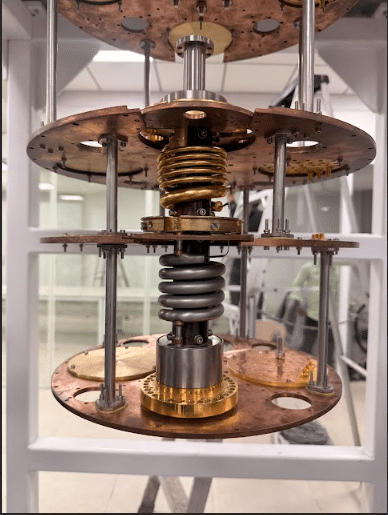
A. The early-stage challenges came from the extreme precision required across both electronics and mechanical systems in a quantum setup. Even components like the plates inside the dilution refrigerator needed an ultra-fine surface finish. While copper is easy to source, it oxidises, which affects conductivity, so we had to gold-coat it and achieve a very high level of polish by working with multiple vendors.
At the same time, partners like Sidwal, who typically work on AC systems, metro cooling, and even missile cooling, had to extend their capabilities into cryogenic conditions, which was entirely new for them. A large part of the effort was essentially about pushing existing industrial capability into a completely new regime of precision and temperature control.
Q. How did you address challenges around qubit stability, coherence, and noise?
A. We are currently sourcing qubits from the Tata Institute of Fundamental Research and working closely with teams at the Indian Institute of Science, especially Vijay Raghavan and Vibhor Singh, who have been working on coherence, noise, and precise control for years. A significant part of solving these challenges comes from their deep domain experience, which has been critical for us at this stage. At the same time, this collaboration has given us confidence as we continue to learn and build. Going forward, the focus is on scaling to larger chips, improving system performance, and eventually building everything in India at a world-class level, which is essential for gaining real control over the supply chain and competing globally.
Q. Can you expand on which parts are sourced from outside India and what you aim to build locally going forward?
A. Taking the dilution refrigerator as an example, it spans multiple temperature stages from about 50 Kelvin down to nearly 10 millikelvin. The initial cooling stages at 50 and 4 Kelvin use a pulse tube cryocooler imported from Japan, while the deeper cryogenic system, including the mixing chamber, heat exchangers, and helium-3 and helium-4 gas-handling system, has been built in India. Overall, more than 50 per cent of the system is locally developed, and the process has clearly identified which components need to be built within the country.
No quantum system globally is fully localised; even companies like IBM source components worldwide. The key difference here is transparency in clearly separating what is imported and what is made in India, which is already driving local development, with components like thermometers now being taken up domestically and early work beginning on cryocoolers. The roadmap is to progressively localise high-value components in phases while continuing essential imports, with the long-term goal of strengthening and scaling the domestic supply chain.
Q. Which components still depend on the global supply chain?
A. Many components still depend on the global supply chain, and the key challenge is scale rather than know-how. Take processors, for example: while we can source them within India, current production is limited to just a few chips a year, which is far from sufficient for multiple quantum systems. Fabrication is still at the lab scale, where even a single chip can take months to produce, making it difficult to meet demand. So even if the knowledge exists, we still rely on imports until manufacturing scales up.
This limitation directly impacts growth because systems cannot be built fast enough despite demand. The gap is not capability but production capacity, and that is what needs to be fixed. Efforts are underway across government and industry to strengthen this, and the expectation is that the supply chain will improve significantly in the near term. For a country like India, building a few systems is not enough; we need to scale to hundreds of systems to match existing talent and demand.
Q. Are there any proprietary innovations or differentiators in your design?
A. Yes, there are several proprietary elements in our design, and we are already filing patents along with our partners who are building different components. In quantum systems, nearly every part is highly specialised, with only a few global players working on areas like cryocoolers, dilution refrigerators, and amplifiers, so much of what we are building is inherently proprietary even within a collaborative model. At the same time, this is a collective effort because quantum computing cannot be built by a single startup alone due to the scale of investment required. Our approach is closer to a cooperative ecosystem, where different contributors build different parts of the stack, and if sustained, it can position India as a global leader in quantum technologies.
Q. What does your core team look like in terms of expertise and roles?
A. I come from IBM, where I led quantum in India for 27 years before starting this. The team brings together experienced and young talent, including Gopal Joshi, who retired from the Bhabha Atomic Research Centre, researchers with experience at Delaware, Tufts, and Harvard, and strong local contributors. Despite thousands of applications, we have structured the team into four core areas: cryogenics, processors, control electronics, and the software layer that integrates them all. What also stands out is how the ecosystem has formed around the work, with students at places like SRM University stepping in to contribute directly, accelerating progress. Building a quantum computer is not only high-end science but also heavy engineering involving machining and materials, and hardware is what brings together this wide mix of physical and digital skills.
Q. Was it a challenge to find the right talent for quantum hardware?
A. Yes, it has been a significant challenge to find the right talent for quantum hardware. Even when we offered high-stipend intern roles, it was difficult to find people with the required skill set. Over the years, India has shifted heavily towards software, so most people associate computing with screen-based work, whereas quantum hardware involves working with physical systems such as wiring, thermometers, and mechanical components, which many lack exposure to. What we really need are people who understand theory but can also build and work hands-on, and that combination is still rare. However, the positive shift is that many colleges are now recognising this gap, actively asking which skills are needed and adapting their curricula, especially as AI reshapes roles and highlights the need for talent that blends physical and digital capabilities.
Q. Do you have any academic collaborations at the moment?
A. Yes, we have extensive academic collaborations. Our chips come from institutions such as the Indian Institute of Science and the Tata Institute of Fundamental Research, and we are working with around 15 universities, including IIT Tirupati, SRM University, IIT Bombay, IIT Delhi, and IIIT Hyderabad. These partnerships include MOUs, joint development, and even funding professors to build specific technologies, intending to translate deep academic knowledge into real products. On the hardware side, while systems are being integrated in India using both domestic and global components, the larger focus is on building a strong component ecosystem by identifying what can be developed locally, what still needs to be imported, and gradually reducing dependency to achieve long-term control over the entire stack, especially as some critical components may face global restrictions.
Q. Are you currently looking for industry partners as well?
A. Yes, absolutely. We already have strong academic collaborations, but now the focus is also on industry partners. As we move towards scaling, many components need to be manufactured in India, and we do not produce everything ourselves. So if companies that already have manufacturing capabilities come in and collaborate, it will significantly accelerate the ecosystem.
Q. What kind of capabilities are you looking for in industry partners?
A. We are mainly looking at precision manufacturing capabilities on the industry side, especially CNC machining, lathe work, and fabrication of precision plates, wires, and mechanical parts, which many industries already have and can execute more efficiently than we can internally. There is also scope for deeper collaboration, in which industrial partners can connect with scientific teams building core components and help scale them through fabrication and industrial-level processes. What has changed recently is clarity; earlier, the exact requirements were not fully defined, but after recent engagements at Medha Towers and SRM University, the roadmap has become much clearer, opening concrete opportunities for industry to directly contribute.
Q. How do you see monetisation evolving in this space over the next few years?
A. The quantum computing industry is expected to become a multi-billion-dollar market, but the key question for us is how much of that India will actually capture. By 2030 and beyond, the opportunity will be significant, but if we do not start building capabilities today, we risk missing a meaningful share. It is not about whether the market will grow; that is already clear, but whether we position ourselves early enough to benefit from it. Reports from NITI Aayog also highlight that India’s position by 2035 will depend heavily on the investments and ecosystem we build now, and the difference could be between owning a substantial part of the market or barely participating in it, which is why the focus today is on building capabilities and strengthening the ecosystem.
Q. What is your current funding status, bootstrapped or government funded?
A. So far, we have largely been bootstrapped, with most funding coming from the founders and strong support from Amber Enterprises, which has helped with components and infrastructure. We are now exploring external investment and government funding, and after the April 14 milestone, there has been a noticeable surge in investor interest. At this stage, we are not under immediate pressure to raise capital, and in many cases, we are even redirecting investors to other startups in the ecosystem, building specific components, as the larger goal is to strengthen the entire quantum ecosystem, not just one company. The broader view is that deep tech growth does not come from a single player but from clusters of startups working together, similar to Silicon Valley and India’s own industrial ecosystems, where proximity, collaboration, and shared momentum drive long-term growth.
Q. What are the biggest hurdles that could slow you down?
A. The biggest hurdles that could slow us down are:
- Supply chain: Manufacturing capacity remains limited, which restricts how quickly systems can be built and delivered.
- Talent: India has strong scientific talent, but there is a shortage of hands-on hardware experience needed for quantum systems.
- Funding: Deep tech capital in India remains cautious, with investors preferring lower-risk areas despite emerging support such as the National Quantum Mission.
- Operational and policy barriers: Paperwork, import duties, and structural inefficiencies create friction and slow execution for early-stage startups.
- Global imbalance: Competitors often get duty-free access to components along with strong government support in land, infrastructure, and incentives, while Indian startups face additional costs and procedural hurdles, even as foreign players can freely enter the market, impacting the broader deep tech ecosystem.
Q. What is the story behind the name Qbit Force, and where is it based?
A. The name came from Jasbir Singh of Amber Enterprises. During brainstorming, ‘Qubit’ was the initial choice, but it was not available for registration, so it was shortened to ‘Qbit.’ The name reflects how different forces have come together to build this effort. Even the logo was a collective process, involving family discussions and internal polling to choose what resonated most. These moments, though small, were among the most meaningful, as they captured the collaborative spirit behind the entire journey.
Q. Where is your headquarters, and why was that location chosen?
A. We are headquartered in Amaravati, primarily because of the strong support from the state leadership and the clarity and speed in execution. Even during my IBM days, Amaravati was already part of early discussions around bringing quantum systems to India. What stood out was faster decision-making and smoother administrative processes compared to other regions.
Another key factor is the emerging ecosystem, with multiple startups emerging, making clustering essential for deep tech development, as it cannot happen in isolation. Combined with lessons from global tech clusters, this environment played a major role in the decision, and the pace at which things came together in just four months still feels exceptional.
Q. What are your next key milestones in terms of scaling systems or capabilities?
A. What we built on April 14 is a first step, a three-qubit system, but the platform is flexible, so higher qubit chips like 30 or 40 qubits can be integrated, making it a reference system where qubit scaling is not the main constraint. The focus now is on scale and execution: demand exists, but supply cannot yet match it. The next milestone is strengthening the supply chain and moving to a structured, assembly-line-style manufacturing model to build and deliver systems consistently, to scale up and compete globally by year-end.
Q. Are you looking for any global collaboration or expansion as well?
A. Not actively right now. We are seeing interest from abroad and are open to exporting our systems, but we are not consciously pursuing global collaborations at this stage. The focus is on building strong partnerships within India across academia, industry, and the broader ecosystem. If international collaborations arise organically, we are open to them, but they are not a priority right now.
Q. As these systems evolve, what are the key security concerns, especially around encryption, and how should organisations prepare?
A. One of the biggest impacts of quantum computers will be their ability to break today’s encryption, which is a very serious shift because almost everything today depends on encrypted communication, from banking and personal data to communication systems and even defence infrastructure. If that encryption is broken, bank accounts, private data, calls, and online communication could all become vulnerable, and, in extreme cases, even systems like missile guidance that rely on encrypted signals could be affected, marking a fundamental shift in how security works. Because of this, the entire encryption ecosystem has to move towards quantum-safe encryption, with new standards already being developed but requiring a full transition across layers like WiFi, banking, and government systems. At the same time, this creates a major opportunity, with growing demand for cryptography and cybersecurity expertise to redesign systems for the quantum era, so organisations need to start preparing now rather than waiting for disruption.
Q. How did your Make in India thinking evolve after 27 years at IBM?
A. Even within IBM India, the focus was always on building world-class work from here alongside global teams across IBM US, Israel, Australia, and others, so capability was never in question, and India consistently delivered at a high level. However, over time, it became clear that while much of the work was built in India, the ownership and product identity often remained outside, making Indian contributions less visible at the product level. That realisation led to a shift in thinking at Qbit Force, from being only contributors to building and owning products from India, with the aim of the next generation taking this even further.
Q. Can you expand on the Amaravati Quantum Valley and how it is evolving?
A. Amaravati Quantum Valley is being built as a full-stack ecosystem, starting with skilling at scale to create a strong talent base that naturally attracts companies. Alongside this, there is active support for startups through policy, infrastructure, and faster execution, which is helping companies get started more quickly. What stands out is the strong focus on hardware and real execution, with infrastructure built based on what startups actually need, so they do not have to solve everything alone. With a clear willingness to move fast and take risks, it is evolving into an execution-driven ecosystem rather than just a policy initiative.
Q. What has stood out to you most since the April 14 milestone?
A. What stood out most after the April 14 milestone was the response. While interest from the technical community was expected, what surprised us was the strong support from the non-technical community, including government stakeholders, reaching out to ask how they could help take this to the next level. That kind of response has been overwhelming and shows a broader belief building around this space. More importantly, this momentum needs to extend beyond us to the wider deep tech ecosystem, because only a small fraction of startups in India are in deep tech today, despite the potential. It feels like an early-internet-era moment, where the real impact will come when more young founders start building on top of it in ways we cannot yet imagine.
Q. Would you like to share any message with our readers?
A. We already have the talent in India; what we need now is the confidence to build. For a long time, we have been strong in software, but this is the moment to start creating real products that people can use, bringing the real and cyber worlds together to solve practical problems around us. I would especially say to young people, do not hesitate to build, because the tools and knowledge are already accessible, and there is so much to solve in healthcare, the environment, and everyday challenges, and that is where the next wave of innovation from India will come from.