






Existing 5G infrastructure can double as a sensing network, using radio reflections and AI-based processing to detect, locate, and track drones without dedicated radar systems.
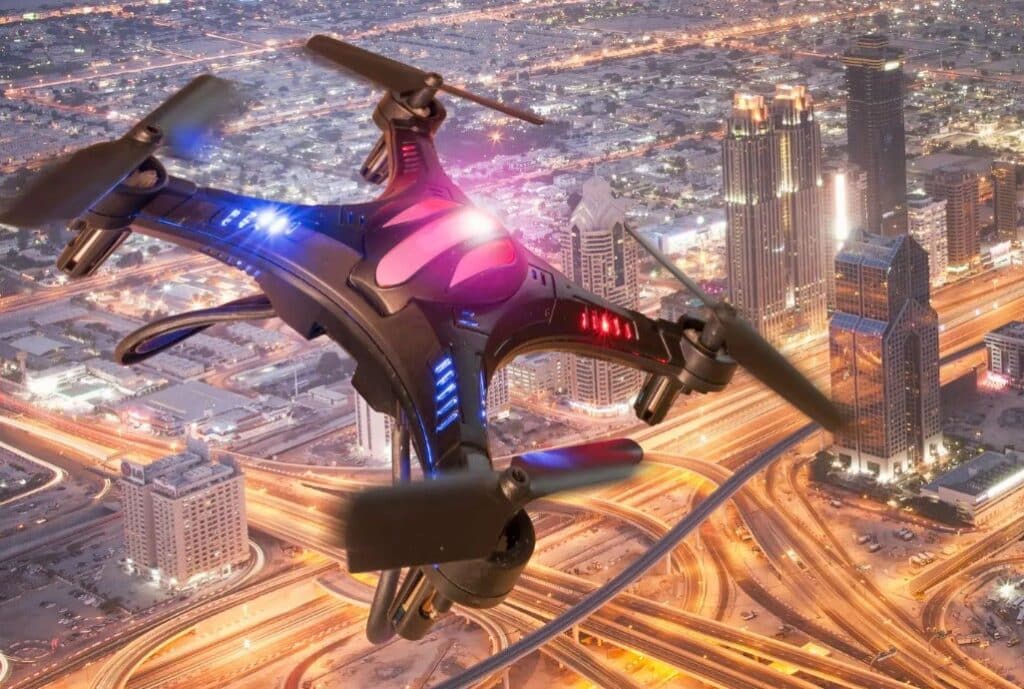
Existing 5G networks can be used to detect and track drones, turning cellular infrastructure into a distributed sensing system without requiring dedicated radar hardware. A recent demonstration by AT&T and Ericsson showed the approach outside AT&T Stadium in Arlington, Texas, where multiple drones flying at about 300–400 feet were detected and tracked in real time.
The technology relies on network sensing, an approach related to integrated sensing and communications (ISAC). Instead of using radio signals only to transmit data, 5G base stations can analyse how those signals interact with objects in the surrounding environment. Ericsson used existing cellular sites equipped with Massive multiple-input and multiple-output (MIMO) radios in a multi-static configuration, allowing signals from several locations to contribute to detecting aerial objects. Advanced signal processing and AI-based sensing algorithms then helped determine the drones’ positions and movement.
The key advantage is that the sensing capability can be added to infrastructure that already exists. Conventional drone-detection systems may require separate radar, cameras, or other dedicated sensors. Using cellular networks instead could provide broader coverage while reducing the need for additional sensing hardware. The approach can also operate across multiple network sites, creating a wider detection area than a single sensing point.
For electronics and wireless-system designers, the development highlights a shift in how RF hardware can be used. Antenna arrays, beamforming, Massive MIMO and signal-processing hardware originally designed for communications can also contribute to environmental sensing. This could make future wireless networks multifunctional platforms rather than communication-only systems.
Potential applications include monitoring airspace around stadiums, airports, industrial facilities and other critical infrastructure. The technology could provide an additional layer for identifying and tracking drones approaching restricted areas.
The demonstration also points toward 6G, where sensing and communications are expected to become more tightly integrated. However, current 5G network sensing remains an emerging technology, with practical challenges such as accurately distinguishing drones from other objects and maintaining reliable detection under changing environmental conditions.
