

Heart rate and skin temperature measurements help a student-built wearable assess heat and hydration stress and guide users on when to rest, drink or cool down.
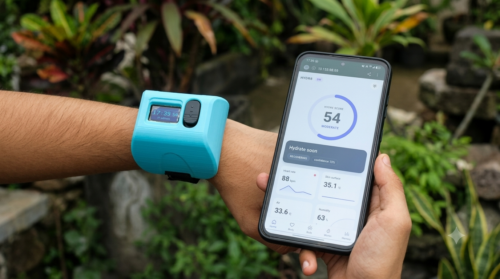
Ayushmaan, an electrical and electronics engineering student, has developed HYDR8, an open-source wearable that monitors heat and hydration stress and provides specific guidance on what the wearer should do. The project was inspired by a simple problem: forgetting to drink enough water while staying focused on work.
At the core of HYDR8 is a Seeed Studio XIAO ESP32-C3 microcontroller module, connected to sensors that measure heart rate, blood oxygenation, skin temperature, ambient temperature and humidity. Instead of relying on a single generic alert, the wearable uses these readings to establish the wearer’s personal baseline before assessing heat and hydration stress.
HYDR8 compares live sensor readings with the learned baseline to calculate a heat and hydration stress score from 0 to 100. Rather than giving the wearer a generic warning, it links the score to the readings driving the change and displays a specific action such as “drink water” or “find shade”. Under normal conditions, the onboard display shows only the time and an alert when the score requires attention — a simple approach likely aimed at keeping power draw low. A dashboard hosted by the ESP32-C3 can also be accessed from a phone to view the sensor trends behind each score.
Fixed phone reminders work on a timer rather than the body’s actual condition, making them easy to ignore when someone is focused on a task. Commercial heat-stress wearables can combine multiple sensor readings, but they are generally designed for industrial safety monitoring rather than individual makers. HYDR8 brings a similar sensor-fusion approach to a low-cost microcontroller platform, with the complete build published so students and hobbyists can replicate it.
Ayushmaan states that HYDR8 is not a medical device but a prototype that cannot directly measure how hydrated a person is. Instead, it estimates heat and hydration stress using indirect sensor readings, with the accuracy depending on how reliably the wearer’s personal baseline has been established. The project doesn’t list a single total build cost, but the parts are all standard, affordable components.
Heatwaves are a recurring public-health concern across large parts of India, with outdoor workers, delivery riders and construction labourers among those exposed to prolonged heat. NDMA and IMD have developed heat-health warnings and action plans to help protect vulnerable populations during extreme temperatures. A low-cost, open-source wearable built around a small microcontroller and commodity biometric sensors could give India’s maker and public-health communities a platform to explore low-cost heat-stress monitoring for occupational safety, without relying on more expensive industrial systems.
HYDR8 started as what its creator described as one of the “things that probably didn’t need to exist”. But in a country where heat exposure is a recurring health concern, a wearable that tells a distracted worker when to drink water or seek shade could offer a simple approach to heat-stress awareness.