





Based in Andhra Pradesh, deep-tech startup Red Balloon Aerospace develops next-generation lighter-than-air platforms for communication, surveillance, and research…
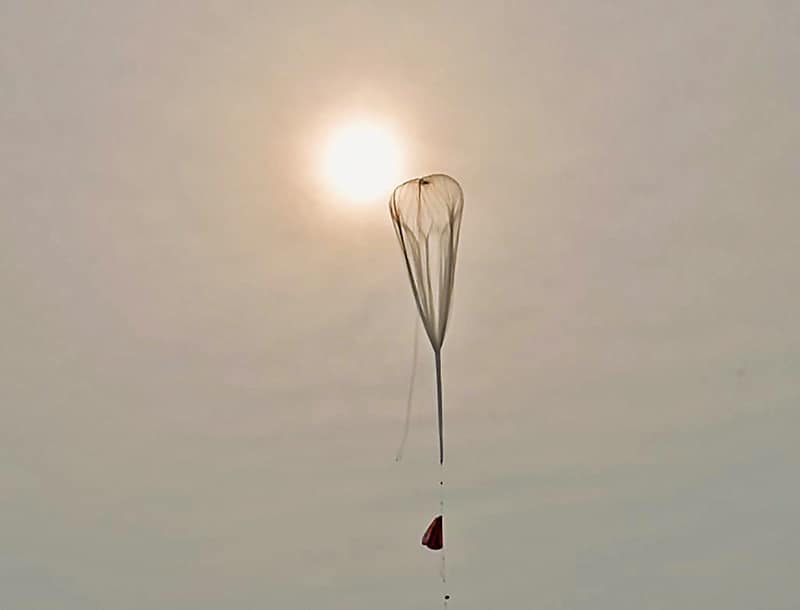
Founded by Dr Chakravadhanula Venkata Sai Kiran and Sireesh Pallikonda, Red Balloon Aerospace Private Limited was established in May 2025. It develops near-space infrastructure that operates at altitudes of 20-50 kilometres, a region between conventional aircraft and satellites that has remained largely underutilised.
The startup develops advanced lighter-than-air platforms for applications such as communication, surveillance, scientific research, environmental monitoring, and disaster management. Its key products include the HELIX high-altitude airships, ALTIS tethered aerostat systems, and VISTA super-pressure balloons. These platforms offer satellite-like observation and communication capabilities but operate much closer to Earth, allowing for higher-resolution imaging, lower latency, and significantly greater cost efficiency.

The startup also offers launch services at customer locations and provides extensive customisation options.
RBA launched India’s first super-pressure balloon on March 27, 2026 through Mission SANA, marking a historic milestone for the country. In terms of commercialisation, its VISTA super-pressure balloon platform has already completed commercial flights, carrying payloads for commercial aerospace partners during Mission SANA.

ALTIS remains under development, while HELIX, the long-endurance stratospheric airship designed for telecom and cargo applications, is expected to enter commercial deployment during this financial year. According to Dr Kiran, the initial HELIX platform is targeted for completion by December 2026, with flight trials expected to begin in early 2027.
“While drones and aircraft typically operate up to about 10-13 kilometres and satellites function hundreds of kilometres above Earth, there has been little infrastructure in the intermediate near-space region,” explains Dr Kiran. This gap exists largely because the atmospheric conditions at those altitudes are extremely challenging, requiring advanced materials and specialised engineering solutions.
“Red Balloon’s proprietary multi-layered nanocomposite materials can withstand harsh temperatures, pressures, and environmental conditions while retaining hydrogen gas for extended periods,” claims Dr Kiran. These materials form the basis of the company’s lighter-than-air platforms that are protected through provisional patents.
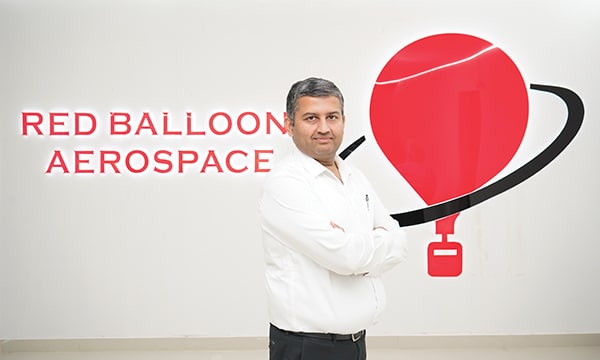
Dr Kiran highlights that the platforms are designed to remain at a stable altitude for prolonged periods, making them suitable for persistent operations. The company’s technology enables payloads ranging from 50 kilograms to 20 tonnes, depending on mission requirements. Customers can choose from rideshare missions, where multiple payloads share a launch, or dedicated launches tailored to specific needs.
Dr Kiran shares that nearly all aspects of design, development, manufacturing, and production are handled in-house. Even many of the manufacturing machines used in production have been designed and built by the company because suitable equipment was not readily available on the market.
“Around 80-90 per cent of the overall system is indigenous, while certain specialised electronic components are still imported due to limitations in India’s current semiconductor ecosystem. However, we intend to collaborate with domestic semiconductor manufacturers as India’s electronics and semiconductor industries continue to mature,” he adds.
While discussing its revenue sources, Dr Kiran explains that the company generates revenue by carrying customers’ payloads, sensors, communication equipment, and technology demonstrators on its VISTA near-space platform through both rideshare and dedicated missions.
The startup claims that its platforms can provide internet connectivity to underserved and remote regions where laying fibre-optic networks or installing cellular towers is economically challenging. A single near-space platform operating at an altitude of around 20 kilometres could potentially replace hundreds of traditional cell towers while delivering high-speed connectivity. The company claims that its systems can achieve data speeds of up to 500Mbps with latency as low as 0.3 milliseconds, significantly outperforming many satellite-based solutions.
According to its estimates, the company’s services can be significantly cheaper while offering up to 200 times the operational efficiency in certain applications. Unlike satellites, which are often discarded after their operational life, Red Balloon’s ALTIS and HELIX airships are reusable. Payloads can be safely recovered, upgraded, modified, and redeployed, reducing both costs and environmental impact.
While discussing future plans, Dr Kiran shares that the company plans to launch ALTIS and a subscale version of HELIX.
The company’s name is inspired by the French Oscar-winning film The Red Balloon. Kiran explains that the persistence and determination shown by the young boy in the film reflect the company’s philosophy of building platforms capable of persistent operation.
Currently, the company operates from a 20,000-square-foot (approx. 1858 sq. metres) facility in Vijayawada and employs around 24 employees, with plans to expand its workforce to nearly 150 in the coming year.



