ClearWay Mobility has developed a sensor-equipped attachment that brings obstacle detection, haptic alerts and location tracking to conventional white canes, demonstrating how compact electronics can enhance independent navigation.
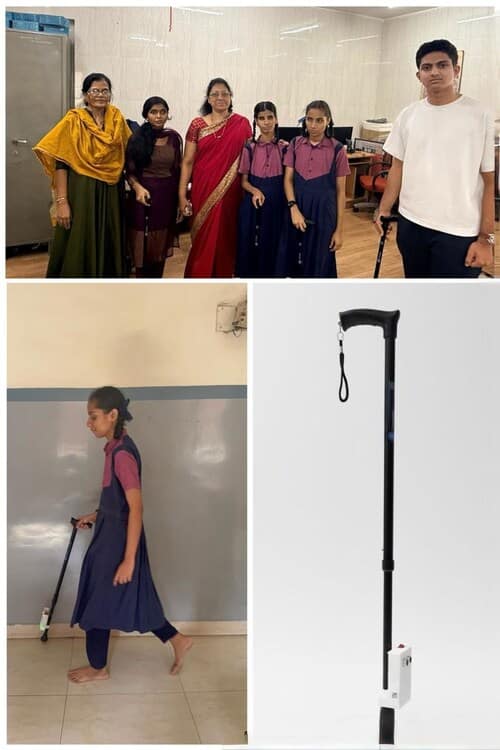
A Mumbai-developed electronic attachment is bringing obstacle detection capabilities to the traditional white cane, using sensors and haptic feedback to provide visually impaired users with additional information about hazards in their path. Called ClearWay, the device is designed to fit onto a standard white cane rather than requiring users to adopt an entirely new mobility aid. The system detects obstacles ahead and communicates warnings primarily through vibration, with optional audio feedback. Its latest development reflects a growing use of compact sensing electronics in assistive technologies aimed at improving everyday mobility.
The technology works independently of a smartphone or mobile application, an approach intended to reduce complexity and make the system easier to use in daily environments. According to ClearWay Mobility, the device has been developed around affordability, reliability and ease of operation.
At the hardware level, the system integrates two sensing zones. A forward-facing ultrasonic sensor detects objects and obstacles in the user’s path, while a downward-facing infrared scanner monitors the ground for hazards such as potholes, drops, steps and uneven surfaces. Together, these sensors extend awareness beyond what a conventional cane can detect through physical contact alone.
The sensor data is translated into haptic feedback, allowing the user to receive warnings without constantly relying on sound—a potentially useful feature in noisy urban environments. The product also incorporates location-support functionality, with the current version offering tracking features intended to help users or family members locate the device when required.
ClearWay originated as a science-fair project in 2021 by Mumbai student Jaiveer Talwar and has since progressed through user testing. A revised version was tested with students and teachers at the Kamla Mehta School for the Blind in Mumbai, where feedback was used to refine the device’s usability and sensing functions.
The project has now moved into manufacturing, with an initial production batch underway. While smart mobility aids have increasingly incorporated cameras, AI and connected devices, ClearWay takes a comparatively hardware-focused approach: adding sensors, electronics and intuitive feedback to an existing tool that users already understand.
The development highlights how relatively compact combinations of ultrasonic sensing, infrared detection and haptic electronics can make conventional assistive devices more responsive to the environment without fundamentally changing how they are used.