What if AI could analyse long streams of data without draining device batteries? IIT Guwahati’s brain-inspired model offers a possible answer.
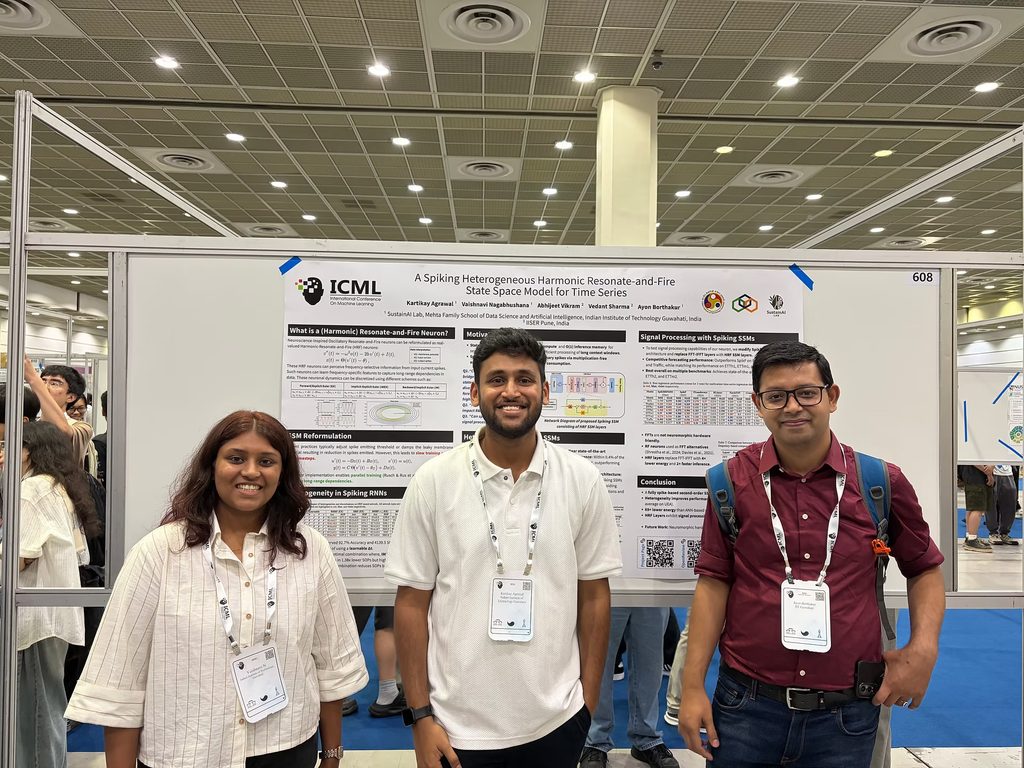
Researchers at IIT Guwahati have developed a brain-inspired AI model designed to process long sequences of data with substantially lower estimated energy consumption than conventional sequence models. Called the Spiking Heterogeneous Harmonic Resonate-and-Fire State Space Model (SH²RFSSM), the architecture was presented at the International Conference on Machine Learning (ICML) 2026 in Seoul, South Korea.
The model targets applications that require continuous data analysis, including wearable health monitoring, IoT sensors, smart manufacturing, environmental monitoring, autonomous systems, and long-term forecasting. Its lower computational requirements could enable more AI processing directly on battery-powered and resource-constrained devices, potentially extending battery life and reducing dependence on cloud computing.
The researchers evaluated SH²RFSSM across 17 benchmark datasets covering long-range sequence classification, regression, human activity recognition, and long-term forecasting. It delivered performance comparable to state-of-the-art sequence models while demonstrating substantially lower estimated energy consumption.
The architecture combines spiking neural networks (SNNs) with state space modelling. SNNs process information through event-driven activation rather than continuously computing every input, enabling sparse computation. State space modelling helps the architecture learn patterns across long sequences without the heavy computational cost associated with some conventional sequence models.
Another feature is neuronal heterogeneity, where individual artificial neurons can have different characteristics instead of behaving identically. The researchers say this helps the model capture complex temporal patterns in real-world sequential data.
Dr Ayon Borthakur, Assistant Professor, Mehta Family School of Data Science and AI, IIT Guwahati, says, “Modern AI systems increasingly rely on analysing long streams of sequential data such as health signals from wearable devices, environmental sensor readings, industrial monitoring data, and weather or traffic forecasts. However, widely used AI architectures often become computationally expensive as the length of data increases, making them less suitable for battery-powered and resource-constrained devices.”