Film capacitors for power converters, inverters, and charging systems can operate at high temperatures and handle electrical stress during operation.
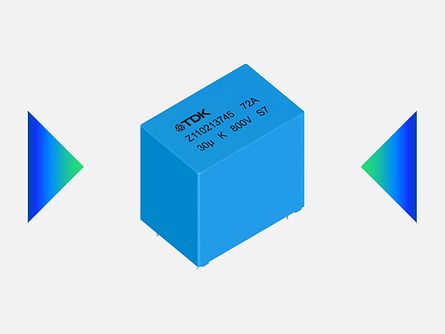
TDK has introduced the B3272*A/G/T series of DC-link film capacitors with rated DC voltages from 800 V to 1200 V and capacitance values from 1.0 µF to 60 µF. The capacitors can operate at case temperatures up to +135 °C, with no derating required up to +105 °C. The series is aimed at xEV traction inverters, on-board chargers, automotive DC-DC converters, industrial drives, and high-end power supplies.
The capacitors use TDK’s EPN dielectric, which combines polypropylene (PP) and cyclic olefin copolymer (COC). TDK also uses the dielectric in its ModCap UHP power capacitors. The higher temperature capability can help in power converters where limited space and higher power density increase the thermal load around passive components.
The B3272*A/G/T series is available with lead spacings of 27.5 mm, 37.5 mm, and 52.5 mm. The 52.5-mm version, designated B32728G, uses four pins to provide a low-inductance busbar connection. This can help reduce parasitic loop area in fast-switching inverter stages. The T variant uses a low-profile construction for applications with restricted component height.
The capacitors have a flame-retardant plastic case and epoxy resin sealing, with both materials meeting UL 94 V-0 requirements. The series is AEC-Q200E qualified and RoHS-compatible. TDK specifies a useful life of 100,000 hours at rated voltage and +85 °C.
The series includes versions with self-healing properties, overvoltage capability, and low losses for high-current operation. These features are relevant to DC-link applications, where capacitors are subjected to electrical and thermal stress during power conversion.
For circuit development, TDK provides SPICE model libraries for the B3272*A/G/T series. Designers can also use the web-based Capacitor Life and Rating Application (CLARA) to evaluate capacitor ratings and lifetime under specific operating conditions.
Click here for the original announcement.