




A new porous material could offer a simpler way to turn sunlight and water into hydrogen.
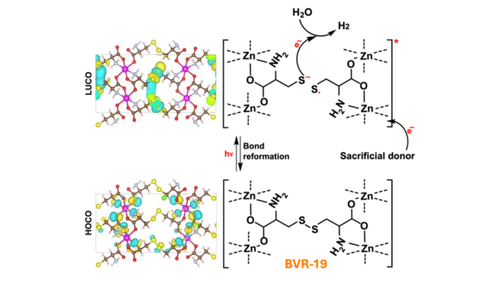
Researchers at Oregon State University have developed a metal-organic framework (MOF) that uses light to drive hydrogen evolution from water, offering a possible route towards solar fuel production without relying on an additional expensive metal co-catalyst. The material, called BVR-19-Zn, achieved a hydrogen production rate of 938 μmol per hour per gram of catalyst in laboratory tests.
The work focuses on a different way of designing photocatalysts. Instead of making the metal centre responsible for most of the light-driven charge transfer, the researchers engineered the organic part of the MOF to perform the key electronic work.
MOFs are crystalline structures made by connecting metal ions with organic molecules called linkers. Their structures can be tuned by changing either component, creating a large design space for applications including catalysis, gas storage and chemical sensing. Oregon State says nearly 100,000 MOFs have already been synthesised, while the properties of another 500,000 have been predicted computationally.
BVR-19 is built using divalent metal ions and L-cystine, an amino acid containing a sulphur-to-sulphur bond. The researchers created several versions using metals including magnesium, manganese, copper, zinc and cadmium. Among them, BVR-19-Zn performed best for hydrogen evolution.
The key behaviour occurs when light reaches the sulphur-containing linker. The S–S bond can undergo temporary homolytic cleavage, producing a thiyl radical and thiolate anion. This creates a pathway for charge separation and allows the photogenerated electrons to participate in hydrogen evolution. In BVR-19-Zn, the zinc centre mainly provides structural and electronic support while the sulphur-containing ligand handles the critical light-driven charge-transfer process.
The researchers call this mechanism intraligand charge transfer (ILCT). In conventional MOF photocatalysts, charge transfer can involve the metal centre, sometimes requiring an additional co-catalyst to help convert the generated electrons into hydrogen. BVR-19-Zn instead places the relevant electronic states on the disulphide-containing organic component. The researchers report that adding nickel phosphide as a co-catalyst increased the hydrogen evolution rate by only about 30 per cent, from 938 to 1,223 μmol per hour per gram.
The other versions of the material performed considerably less effectively. BVR-19-Mn, BVR-19-Mg and BVR-19-Cu produced hydrogen at rates of 73, 48 and 38 μmol per hour per gram, respectively. BVR-19-Cd also performed strongly, reaching 745 μmol per hour per gram, supporting the researchers’ observation that closed-shell metal configurations can favour the ligand-centred mechanism.
The material was also tested repeatedly. BVR-19-Zn maintained hydrogen evolution rates above 350 μmol per hour per gram over six consecutive two-hour cycles. However, the researchers observed a reduction in long-range crystallinity after prolonged irradiation, even though the local chemical features of the L-cystine linker remained intact. This indicates that further work is needed to understand the material’s long-term structural behaviour.
Another notable feature is how the material is made. The researchers synthesised the BVR-19 materials in deionised water at ambient temperature. Oregon State says the spontaneous aqueous synthesis could provide an energy advantage compared with more demanding material-production processes.
The result should not yet be interpreted as a complete commercial solar-hydrogen device. The study demonstrates photocatalytic hydrogen evolution at laboratory scale, rather than a field-ready system that can continuously split water using sunlight. The experiments also investigate hydrogen evolution specifically, so the work does not by itself demonstrate complete overall water splitting into hydrogen and oxygen. That distinction is important when comparing the material with commercial electrolysers.
The researchers see the larger opportunity in the design principle. By showing that the organic linker can control the crucial charge-transfer process, the work provides another route for screening and engineering MOFs for solar-fuel applications. Oregon State estimates that the enormous number of known and predicted MOF structures could provide a large pool of candidates for such optimisation.
For India, the approach is relevant to the cost challenge surrounding green hydrogen. The National Green Hydrogen Mission targets at least 5 million metric tonnes of annual green hydrogen production by 2030, with electrolyser costs and renewable electricity identified as major contributors to production costs. A photocatalytic approach that uses sunlight directly could eventually reduce the need for separate electricity-generation and electrolysis stages, although BVR-19 is still far from demonstrating that at practical scale.
The study therefore offers less of a finished hydrogen generator and more of a new blueprint for designing light-driven catalysts: make the organic component capture the light, separate the charges and deliver the electrons needed for hydrogen production. If that principle can be translated into materials with higher efficiency, longer lifetimes and scalable production, it could open another path towards lower-cost solar hydrogen.
For more information, click here.
