




An ultrathin piezoelectric mesh integrates with cardiac cells to convert their mechanical activity into electricity, pointing toward battery-free power for future implantable and wearable electronics with continuous, distributed energy generation.
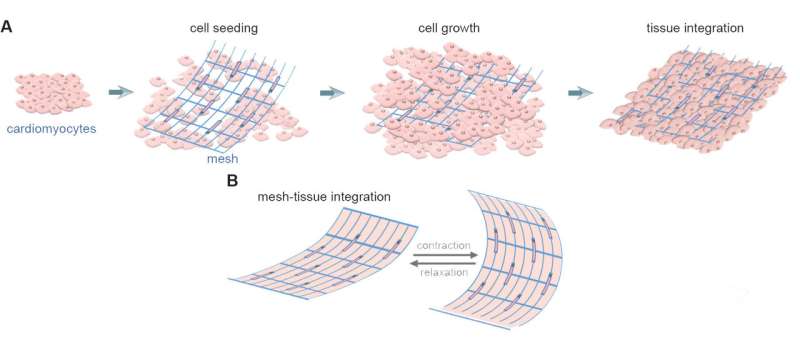
Researchers at the University of Massachusetts Amherst have developed an ultrathin biohybrid mesh that converts the mechanical activity of human cardiac cells into electrical energy. The approach combines lead zirconate titanate (PZT) piezoelectric ribbons with an ultraflexible polymer platform and living heart cells, creating a power-harvesting structure that can mechanically conform to biological tissue.
The technology addresses a major limitation in implantable and wearable electronics: the need for compact, long-lasting power sources. Conventional batteries add bulk, have a finite operating life, and become more difficult to miniaturise while retaining useful energy capacity. Instead of relying on a central battery, the researchers developed a distributed energy-harvesting architecture inspired by how biological systems generate and use energy.
At the centre of the device are thin PZT ribbons, which generate electrical charge when mechanically deformed. The researchers transferred these ribbons onto an ultrathin, flexible polymer substrate before introducing human cardiac cells onto the structure. As the cells grow around the PZT elements and contract, their mechanical movement deforms the piezoelectric material, producing electrical energy.
This integration allows the harvester to move more like biological tissue rather than behaving as a rigid electronic component. It also distributes energy generation across the device instead of concentrating it in a separate battery. According to the researchers, the system achieved about 10 times higher power density than systems using a centralised power source.
The ultrathin construction also provides a potential route to scaling output. Multiple harvesting films can be stacked to increase available power while maintaining a relatively thin form factor. This could be useful for implantable electronics that require continuous energy but cannot accommodate conventional battery packages.
Potential applications include pacemakers, implantable defibrillators, neural stimulators, cochlear implants, and health-monitoring devices. However, the technology remains at the laboratory stage, and further work will be needed to establish long-term biocompatibility, reliability, power-management capability, and practical integration with electronic loads. The researchers describe the architecture as a shift from centralised power storage toward distributed energy generation directly integrated with living tissue, potentially opening another route to battery-free bioelectronics.
