





An online platform helps students learn chip design through practice in Verilog, testing, circuit design, synthesis, and chip layout.
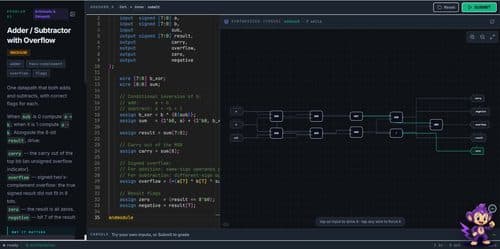
BitForBytes has launched a browser-based learning platform designed to give electronics and electrical engineering students hands-on experience in VLSI and chip design without requiring commercial electronic design automation tools or specialised lab equipment.
The platform provides 95 interactive modules covering electronics fundamentals, digital system design, and Verilog. It also includes an online Verilog judge with more than 106 auto-graded hardware problems. Students can synthesise their designs using Yosys running in the browser through WebAssembly and view live gate-level schematics linked to their code.
Beyond RTL design, BitForBytes includes verification labs covering SystemVerilog assertions, constrained-random stimulus, functional coverage, and Universal Verification Methodology. A design-for-test lab covers scan chains and automatic test pattern generation.
The platform also provides an RTL-to-GDSII flow based on OpenLane and the open-source SkyWater 130nm process design kit. Students can take designs through the physical design flow and view metrics including cell count, die area, timing slack, and design-rule-check results.
Other features include interactive Karnaugh map and finite-state-machine design tools, timed contests, an artificial intelligence tutor, semiconductor interview preparation across 11 domains, and a career roadmap.
BitForBytes is aimed particularly at electronics and electrical engineering students in tier-2 and tier-3 colleges, where access to commercial EDA tools and physical design labs can be limited. The platform is also intended for fresh graduates preparing for RTL design, verification, and physical design roles, working professionals refreshing their skills, and faculty seeking hands-on teaching resources.
The platform requires no installation or commercial licence and is designed to run on an ordinary laptop with an internet connection. Its synthesis workflow runs in the student’s browser rather than on BitForBytes’ servers, allowing the core platform to remain free while reducing infrastructure requirements.
