What does it take for an underwater robot to move from development to naval service? One Indian-built ROV has cleared rigorous field and qualification trials.
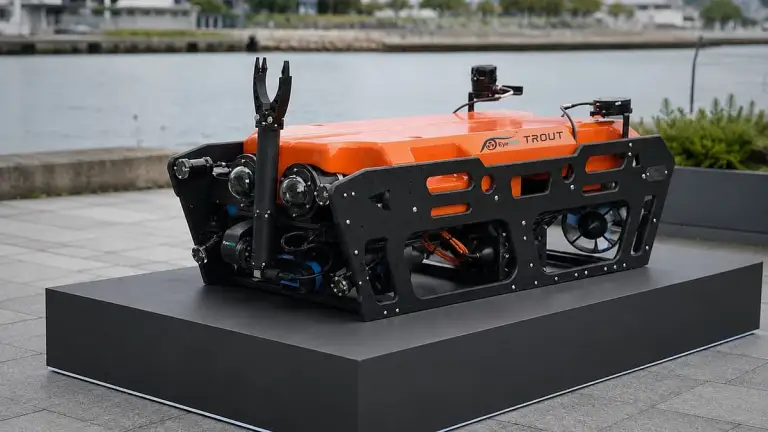
Kochi-based marine robotics startup EyeROV has delivered two TROUT remotely operated underwater vehicles (ROVs) to the Indian Navy, marking the platform’s transition from an indigenous defence development programme to naval deployment. The company is set to deliver five systems under the Navy’s order.
Developed under the iDEX DISC 7 SPRINT Challenge, TROUT is designed for underwater inspection, surveillance and reconnaissance, search and recovery, detection, and robotic intervention. Its development involved integrating mechanical systems, electronics, embedded systems, software, navigation, sensing, communication, and robotic control into a single underwater platform.
The ROV underwent field trials and system-level validation covering manoeuvrability, deep-diving capability, operation in strong underwater currents, detection, navigation, endurance, and operator control. It was also taken through the Directorate of Quality Assurance (Naval) framework and engineered to comply with Environmental Stress Screening requirements under applicable military standards.
The qualification process included type testing to verify that the design performs to specification under defined conditions. These requirements are particularly relevant for underwater operations where poor visibility, strong currents, deep-water conditions, and restricted access can make conventional inspection and recovery difficult.
TROUT is intended to support naval and subsea missions where operators can remotely control an underwater vehicle instead of sending personnel into potentially hazardous environments. Its applications include inspection, surveillance, search and recovery, and underwater intervention.
According to EyeROV, the delivery is its first defence business milestone and follows the development of the platform through the iDEX ecosystem. “Developing a military-grade underwater robotic system requires mechanical engineering, electronics, embedded systems, software, navigation, sensing, communication, and robotic control to perform reliably as one integrated platform,” says Kannappa Palaniappan P., Chief Technology Officer and Co-founder, EyeROV.
The deployment gives an Indian-developed underwater robotics platform an operational pathway within the Navy while building domestic capability across the electronics, sensing, control, and robotics technologies required for subsea systems.