

Samsung expects record quarterly profit as AI demand drives up memory costs, pushing smartphone prices higher and squeezing India’s budget-phone market.
Samsung Electronics expects its operating profit to reach a record ₹107.4 trillion won? Wait, Samsung reports in Korean won: KRW 107.4 trillion for the third quarter of 2026, as demand for memory chips used in artificial intelligence (AI) infrastructure drives a surge in the semiconductor business. The company announced preliminary guidance on 8 October, estimating quarterly sales of KRW 195 trillion. Meanwhile, Indian smartphone buyers are facing rising prices as memory costs increase the expense of manufacturing handsets.
Samsung’s projected operating profit compares with KRW 12.17 trillion in the third quarter of 2025 and KRW 89.49 trillion in the second quarter of 2026. The figures are preliminary guidance rather than audited results, and the announcement does not break down expected performance by business division. Although the memory-chip boom is widely viewed as a major driver of the increase, the final contribution from semiconductors and other businesses will become clearer when Samsung releases its full results.
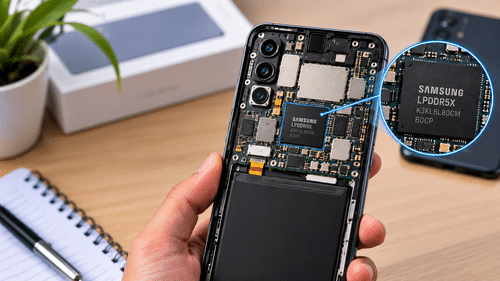
The pressure on smartphone prices stems from two main types of memory. Random-access memory (RAM), commonly based on low-power double data rate (LPDDR) technology in phones, temporarily stores data used by applications and the operating system. NAND flash provides long-term storage for apps, photographs, videos and other files. Both are essential components, and manufacturers cannot simply eliminate them without affecting a phone’s capabilities.
AI data centres are adding to demand for memory. Graphics processing units and other accelerators rely on high-bandwidth memory (HBM), while servers also require conventional DRAM and storage. The expansion of AI infrastructure is increasing competition for manufacturing capacity across the memory industry. However, HBM is a distinct product category, so it would be inaccurate to suggest that every chip used in a data centre directly replaces memory intended for smartphones.
The resulting cost pressure is reaching consumers. According to Counterpoint Research, average smartphone prices in India increased by 16 per cent in the first half of 2026. The average selling price reached approximately US$318 in the April–June quarter, according to the firm’s analysis. Its September report also highlighted substantial increases in entry-level pricing, with phones priced below ₹10,000 experiencing particularly severe pressure.
Separately, International Data Corporation (IDC) reported that India’s smartphone shipments fell 11.1 per cent year-on-year to 33.2 million units in the second quarter of 2026. IDC put the quarter’s average selling price at a record US315.ThedifferencebetweenIDC’sUS315 figure and Counterpoint’s US$318 estimate reflects the separate methodologies used by the two research firms; their estimates should not be combined as if they came from a single dataset.
The decline was especially pronounced in the cheapest segment. IDC reported that shipments of smartphones priced below US$100 fell 74.3 per cent year-on-year, reducing their share of India’s market from 15.6 per cent to 4.5 per cent. This segment is not identical to Counterpoint’s category of phones priced below ₹10,000, so the two sets of figures describe related but different parts of the market.
Memory is becoming a larger component of handset manufacturing costs. Counterpoint’s analysis indicates that memory’s share of the bill of materials for lower-priced phones has risen sharply, putting manufacturers under pressure to increase retail prices, reduce promotional discounts or adjust specifications. Some models may offer less RAM or storage at a similar price, while manufacturers may prioritise products with higher margins. The precise trade-off varies by model and manufacturer, however, and a price increase alone does not establish that a phone’s specifications have been reduced.
The situation creates a difficult balance for smartphone brands. Raising prices can protect margins but risks discouraging buyers, particularly in a market where affordability determines whether consumers upgrade. Keeping prices unchanged can make entry-level models less profitable, encouraging manufacturers to reduce the number of models offered in the lowest price bands or concentrate on more expensive devices.
India is particularly exposed because the country combines a large, price-sensitive smartphone market with dependence on imported semiconductor components. Although most phones sold in India are assembled locally, that does not mean the memory chips inside them are manufactured domestically. Micron’s facility in Sanand, Gujarat, focuses on assembling and testing memory products rather than manufacturing the original silicon wafers, so it does not insulate handset makers from global memory-chip price movements.
The longer-term outlook depends on memory supply, manufacturing investment and the pace of AI infrastructure expansion. If demand continues to outstrip available capacity, smartphone makers may face sustained pressure on costs. For Indian consumers, that could mean higher prices, fewer affordable configurations or less generous specifications at a given price point.
Samsung’s earnings guidance illustrates the scale of the semiconductor opportunity created by AI, but its record forecast does not mean every memory-chip manufacturer or smartphone brand will benefit equally. For buyers, the practical response is to compare RAM, storage, software support and other specifications carefully rather than assuming that a phone retaining last year’s price offers the same value.
For more information, click here.