

A Kochi-developed humanoid robot is expected to undergo trials with Kerala Police, with plans to direct traffic and identify signal violations.
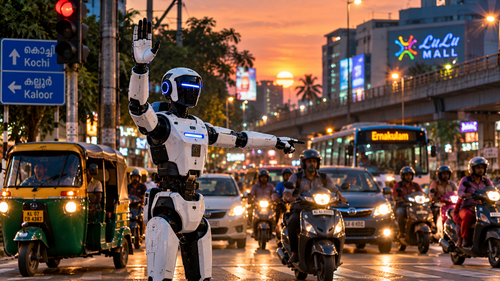
A humanoid robot developed by Kochi-based iHub Robotics is being prepared for traffic-policing trials with Kerala Police. The initiative involves Daksha, a robot designed to direct vehicles at junctions, identify suspected traffic-signal violations and capture images of vehicle number plates. The proposed system would send alerts to the police control room, linking robotic assistance with existing traffic-monitoring operations.
The collaboration was announced at c0c0n 2026, a cybersecurity and policing conference. According to the company’s reported plans, trials could begin in selected jurisdictions, with field deployment targeted within approximately six months. However, the robot has not yet entered routine police service, and the proposed timeline remains subject to testing and customisation.
Daksha Generation 2 uses vision-based perception to interpret its surroundings and respond to traffic conditions. At an intersection, it is designed to guide vehicles through arm gestures, detect suspected signal violations and photograph number plates for further examination. The system is intended to send relevant information to Kerala Police’s Cyberdome control room. The accuracy of its number-plate recognition and violation detection has not been independently established.
The company has also developed Viveka, its own vision-language-action (VLA) model, which reportedly contains 3.3 billion parameters. Such models combine visual information with language-based reasoning to generate actions. In Daksha’s proposed application, this could help connect camera inputs with physical gestures used to direct traffic. The reported system also includes safeguards intended to prevent harmful actions, although their implementation and testing remain to be clarified.
The agreement reportedly covers Kavach, a tracked unmanned ground robot intended for patrolling and disaster-response operations. The system is described as weighing approximately 500kg and carrying 3D lidar sensors and an Nvidia Jetson Thor computing platform. The company has also reported a battery operating time of around two days. Its proposed equipment options include water cannons and tear-gas launchers, with their operation controlled by a human operator. These specifications and capabilities require confirmation through official product documentation.
Humanoid robots have also been tested for traffic-management tasks elsewhere. In Hangzhou, China, DEEP Robotics’ DR02 humanoid robots were reported to have directed traffic and reminded road users about safety requirements. The reported demonstrations included identifying riders without helmets, but did not establish that the robots could issue fines autonomously. Daksha’s proposed integration with a police control room and number-plate recognition system could give it a different role, although comparative performance data are not yet available.
The Kerala initiative remains at the trial-planning stage. The system will need to be evaluated under real traffic conditions before its suitability for routine use can be established. Among the important questions are how the robot will perform during monsoon rain, high temperatures and dense two-wheeler traffic, and how the police will verify incorrect detections before taking action against motorists. The company has not publicly established a weatherproofing rating or independently verified recognition-accuracy figures in the information available for this report.
The project represents an attempt to apply domestically developed robotics and AI to public infrastructure, particularly traffic management and road safety in Indian cities. If trials demonstrate reliable operation, Daksha could provide Kerala Police with another tool for traffic management and monitoring. Its performance will depend on how accurately it interprets road conditions, how safely it interacts with drivers and pedestrians, and how effectively its alerts integrate with existing police procedures. A successful pilot could also provide a practical reference for other Indian cities exploring robotic assistance in traffic operations.