

A solvent-based method developed by BARC scientists selectively extracts lithium from natural seawater and retains its recovery rate across five reuse cycles.
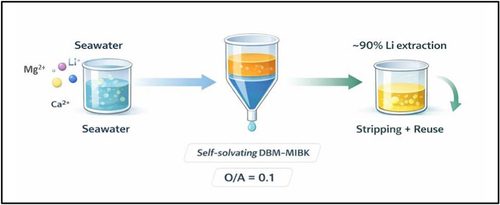
Lithium used in electric vehicles, smartphones and energy storage systems could potentially be recovered from seawater using a method developed by scientists at the Bhabha Atomic Research Centre (BARC). The researchers achieved about 90 per cent lithium extraction from natural seawater under optimised laboratory conditions, using an organic solvent system that can be reused.
The study, titled Development of a Novel Selective Extraction System for Lithium and Application to Its Secondary Resources. The technique was also tested on secondary lithium resources, including coal fly ash and spent lithium-ion batteries. However, the work remains at the laboratory stage, rather than demonstrating a commercial extraction plant.
The method uses solvent extraction, in which lithium transfers from an aqueous solution into an organic liquid. The researchers first treated the seawater sequentially with sodium hydroxide and sodium carbonate to adjust its alkalinity and separate interfering ions, including magnesium and calcium. They then introduced dibenzoylmethane (DBM), a compound that binds lithium, dissolved in methyl isobutyl ketone (MIBK).
MIBK performs two functions: it acts as the extraction solvent and helps stabilise the lithium-containing complex. This eliminates the need for additional synergistic agents used in some conventional solvent-extraction systems. By controlling the contact time between the liquids, the researchers maintained the separation needed to recover lithium without persistent emulsion formation. Dilute nitric acid was subsequently used to transfer the extracted lithium into a separate solution.
Under optimised conditions, the DBM–MIBK system achieved approximately 90 per cent lithium extraction at an organic-to-aqueous phase ratio of 0.1. This corresponds to 100ml of organic liquid for every litre of aqueous solution, substantially reducing the initial solvent requirement compared with the conventional systems discussed in the paper. The researchers also reported effective separation of interfering multivalent ions during the alkaline preconditioning stage, an important consideration because seawater contains far more magnesium than lithium.
The team tested solvent reuse over five cycles, maintaining lithium recovery at about 90 per cent while progressively increasing the lithium concentration in the solution produced during the stripping stage. However, the process was not loss-free: approximately 10 per cent of the organic liquid was lost per cycle and needed to be replenished. This solvent loss, alongside the need to control mixing conditions and manage chemical waste, will be important when assessing the economics and environmental performance of a larger system.
The technique addresses a major challenge in seawater extraction. Although oceans contain a vast quantity of dissolved lithium, its concentration is extremely low, making recovery difficult compared with extraction from concentrated mineral deposits or underground brines. Conventional lithium production includes hard-rock mining and brine processing, with the latter often relying on evaporation ponds. A seawater-based method could offer another potential source, but extraction efficiency alone does not establish whether it can compete with existing production routes. The study does not demonstrate industrial-scale output or establish a commercial cost per kilogram of recovered lithium.
The research is relevant to efforts to reduce dependence on imported lithium materials. The country has pursued overseas resources through Khanij Bidesh India Limited (KABIL), a government-backed joint venture, while the Geological Survey of India identified inferred lithium resources of 5.9 million tonnes in the Salal-Haimana area of Jammu and Kashmir in 2023. These are separate efforts to strengthen domestic access to critical minerals; the identified resource should not be confused with a proven, commercially recoverable reserve.
The BARC method could eventually complement these efforts if further research establishes its scalability, solvent recovery, operating costs and environmental impact. Its application to spent batteries and coal fly ash also points towards recovering lithium from existing waste streams, rather than relying exclusively on primary sources. For now, the results provide a laboratory-scale route to investigating lithium recovery from seawater and secondary resources, with further engineering needed before the method can contribute to India’s battery-material supply chain.
For more information, click here.