

A light-triggered chemical process has produced organic semiconductor materials with promising charge transport properties, potentially advancing flexible displays and wearable sensors through molecular structures designed for more efficient electrical conduction.
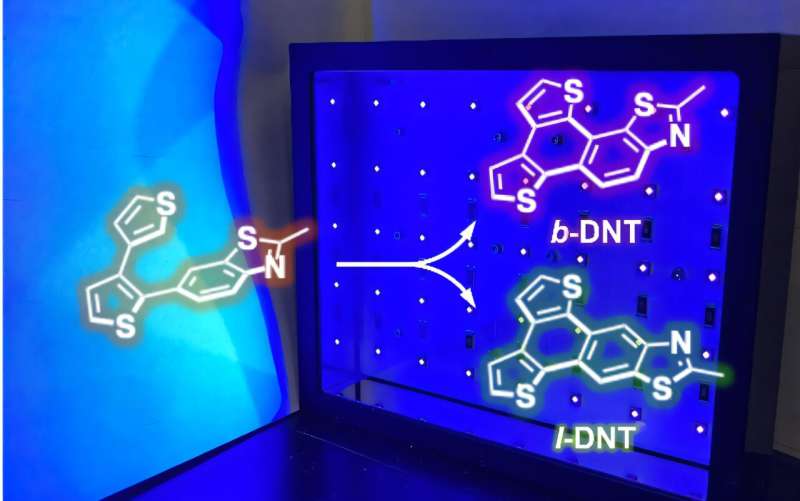
Researchers at Osaka Metropolitan University in Japan have developed two organic semiconductor materials using a light-driven chemical reaction, with one showing a theoretically predicted hole mobility around five times higher than the other. The approach could support the development of lightweight, flexible electronic devices, including bendable displays and wearable sensors.
The materials, named b-DNT and l-DNT, differ in their molecular structures, which influence how they arrange themselves in crystals and transport electrical charge. The findings were published in Chemistry—A European Journal.
Organic semiconductors use carbon-based molecules to transport electrical charge. Their performance depends partly on how closely and regularly the molecules pack together, as this arrangement determines how efficiently charge carriers move between neighbouring molecules.
The research team used a photochemical reaction to transform a precursor containing sulfur and nitrogen into two new semiconductor molecules. When exposed to light, the precursor formed new carbon-carbon bonds, causing parts of its molecular structure to fold into a compact ring.

By changing the irradiation conditions, the researchers could produce a mixture of the bent b-DNT and linear l-DNT structures or selectively obtain b-DNT.
To understand how the transformation occurred, the team used laser flash photolysis and nanosecond absorption spectroscopy to observe short-lived chemical intermediates. Density functional theory calculations helped analyse the reaction pathways and explain how the two molecular structures formed.
Crystal structure analysis showed that both materials formed closely packed crystals, supported by interactions between sulfur atoms and between sulfur and nitrogen atoms. However, the linear l-DNT structure allowed greater overlap between neighbouring molecules, creating more favourable pathways for charge transport.
This structural difference is significant for p-type organic semiconductors, in which positive charge carriers, known as holes, move through the material. Efficient hole transport can improve the electrical performance of organic electronic devices.
Based on crystal structure analysis and theoretical calculations, l-DNT was predicted to achieve approximately five times the hole mobility of b-DNT, reaching a level comparable to leading organic semiconductor materials, according to the researchers. This result is a theoretical prediction rather than a demonstrated device-level performance measurement.
The study demonstrates how combining light-driven synthesis with molecular design incorporating a thiazole unit could help researchers develop organic semiconductor candidates with improved charge transport. Further work will be needed to establish their practical performance and suitability for manufacturing flexible electronic devices.