

A regulator supplies power to processors, reduces voltage drops, and supports current delivery in a compact package for AI systems.
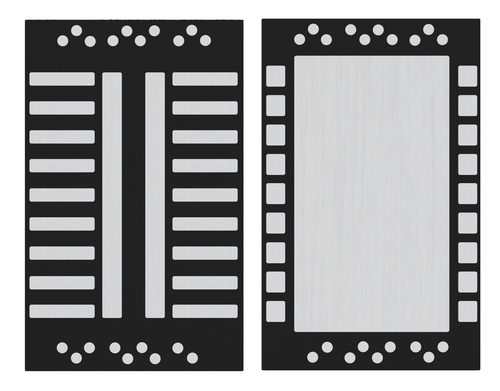
Ferric has introduced the Fe1767 Newport, a 145 A dual-sided integrated voltage regulator (IVR) designed for AI and high-performance processors. Its vertical power delivery architecture reduces transient voltage droop by 19% to 30% compared with competing IVRs and by up to approximately 57% compared with traditional lateral power delivery.
The Fe1767 Newport creates a direct vertical power path between the printed circuit board (PCB) and the processor. Input power enters through the PCB-facing side of the regulator, while regulated output power exits toward the processor. This shorter electrical path reduces power delivery network (PDN) impedance, helping maintain stable voltage when processor loads change rapidly.
Under equivalent load-step conditions, Newport also reduces power rail PDN impedance by 42% to 63% compared with backside PCB attachment, depending on the integration configuration. Lower impedance and voltage droop give processor designers more flexibility to reduce voltage guardbands and output capacitance requirements. This can improve power delivery efficiency while reducing the overall solution footprint.
The regulator has a thermal design current of 145 A and a current density of 2.9 A/mm². It comes in a 5.6 × 8.9 × 1.2 mm package and supports input voltages from 1.2 V to 2.0 V and output voltages from 0.25 V to 1.25 V. Its nominal switching frequency is 15 MHz, which can be programmed between 10 MHz and 60 MHz.
The Fe1767 Newport achieves up to 90.5% efficiency with a 1.8 V input and a 0.75 V output. Its dual-sided termination supports direct vertical power delivery, addressing the need for high current and low impedance in processor power supply designs.
“Delivering current is only part of the challenge—the harder problem is delivering it to the processor without excessive impedance and voltage droop,” said Noah Sturcken, CEO of Ferric. He added that Newport’s dual-sided architecture shortens the power delivery path, enabling tighter voltage regulation in a compact, high-current solution.