

The startup’s innovation integrates separate controllers, sensors, and motor drivers into a single, flexible industrial automation platform.
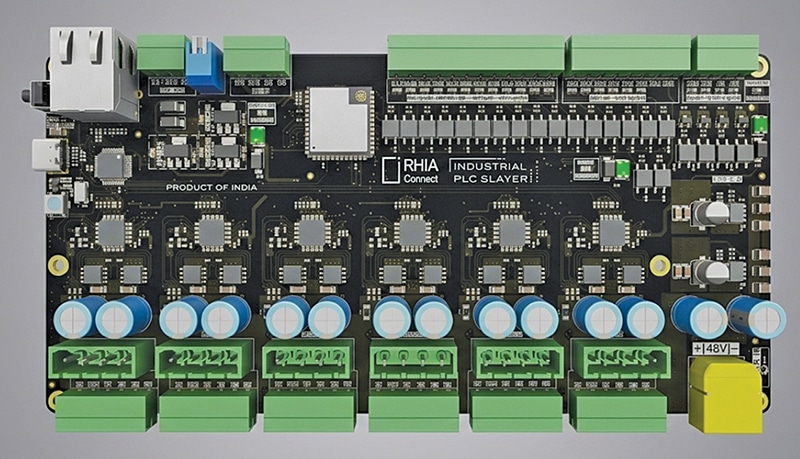
Does building industrial-grade automation always have to be fragmented? Solving a real-world problem while developing custom hardware for Freshot foodbots, Bengaluru-based startup RHIA found itself confronted by this question. The experience made them think differently about hardware architecture, thus sparking the birth of the PLC Slayer, a single, compact platform that unifies the scattered elements.
“We started seeing how industrial machines depended on multiple independent systems for PLC control, motion, motor control, I/O, sensing, and connectivity,” says Praveen Olekar, senior business development manager at RHIA. “Bringing all these systems together can make automation complex, expensive, and difficult to integrate.”
The Freshot learnings helped shape the creation of a single, unified platform that brings these core functions together. The simplified architecture provides developers, startups, original equipment manufacturers (OEMs), and system integrators with a more flexible starting point for building or modifying automation systems.
At its core, PLC Slayer uses an ESP32 dual-core MCU as its control engine. The platform supports industrial Ethernet, RS485, and controller area network (CAN) bus connectivity, alongside Wi-Fi and Bluetooth. It integrates industrial I/O and six stepper/DC motor drivers, with support for open- and closed-loop motion control and a current capacity of up to 5A per channel.
RHIA is positioning the platform for connected automation through edge-to-cloud connectivity and industrial sensor integration, extending its role beyond standalone machine control.
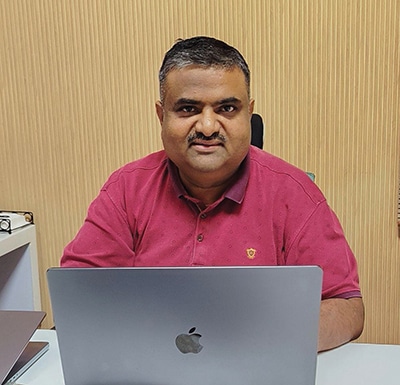
“The PLC Slayer is designed to be flexible and customisable rather than being limited to a single application. It can be used for applications involving motor control, conveyors, and other industrial automation requirements. We are also seeing applications in areas such as water technology and smart water automation. There is interest from customers working on applications such as vending machines and from small industries,” Praveen explains.
The engineering challenges that led to the PLC Slayer also drove RHIA to develop its own industrial sensors and industrial internet of things (IIoT) solutions. This portfolio, covering radio frequency identification (RFID), object detection, and distance measurement, was built entirely to solve specific hardware problems found during customer projects. For example, when commercial sensors failed to accurately measure temperatures between 300°C and 400°C near a cooking area, RHIA developed its own non-contact pyro sensor with RS485 communication. This pattern of finding a practical problem and engineering a custom solution has become the company’s defining approach to product development.
Alongside its own products, RHIA also undertakes specialised engineering projects. In one recent project, they delivered around 2000 printed circuit boards (PCBs) for an industrial application in the oil sector involving DC motor-driver control.
The broader direction reflects a shift towards automation systems that combine control, sensing, communication and connectivity more closely. For RHIA, the challenge is not simply to add more components to industrial machines, but to explore whether some of the technologies traditionally deployed separately can be integrated more effectively.
Founded in 2023 by Sharan Hiremath, the company operates on a bootstrapped model. The hardware and embedded development are carried out internally by RHIA’s team, which also handles assembly and testing. The company’s engineering team currently includes around 12 people working across hardware design, embedded firmware and software development.
On the thought behind the company’s name, Praveen explains, “We chose the name RHIA because we wanted to represent our role as a helping hand for people and organisations that need support with hardware, embedded systems, IoT and industrial IoT technologies. RHIA stands for ‘Right Hand Interactive Assistant’.”
According to Sharan, the future of industrial automation is not about adding more components, but about making machines simpler, smarter, and more connected. “With RHIA,” he says, “we are building that future from India.”
While the company’s journey is still at an early stage, its focus remains clear. They want to build reliable industrial technology from India for real-world industrial applications and create solutions that deliver measurable value to customers. This will be done by bringing control, sensing, connectivity, and intelligence together in a way that helps shape the next generation of industrial machines and automation systems.