

The 10.1-inch touchscreen combines MIPI display and camera interfaces, built-in speakers and audio connections to turn the Arduino UNO Q into an embedded HMI platform.
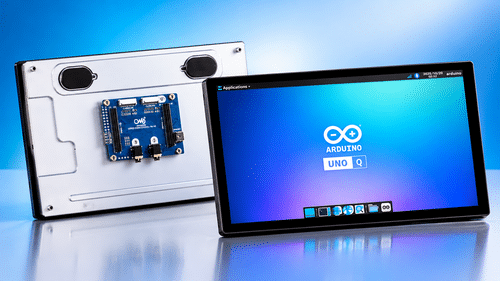
Waveshare has introduced the UNO-Q-DSI-TOUCH-10.1A, a 10.1-inch touchscreen designed specifically for the Arduino UNO Q single-board computer. The display connects through the UNO Q’s 60-Pin JMEDIA and JMISC interfaces, eliminating the need for a separate display adapter or the Arduino UNO Media Carrier. It combines a display, connections for camera and audio equipment in one unit. It is mainly used for embedded applications like control panels, interactive terminals and multimedia applications.
The accessory board uses an IPS panel with a resolution of 1280 × 800 pixels, 60Hz refresh rate. Also the 300cd/m² brightness and an 800:1 contrast ratio provide solid, clear visuals. The touch screen technology is a capacitive multi-touch screen and communicates through the I2C bus protocol. The tempered glass with optical bonding protects the screen, while the metal backplate provides structural support. The complete assembly measures 239 × 147 × 19.11mm, excluding the Arduino UNO Q board. Power is supplied at 5V through USB-C, with the UNO Q’s power connection or an additional USB-C input on the display assembly available for this purpose.
For camera applications, the board provides two 22-pin MIPI CSI connectors, designated CAMERA0 and CAMERA1. These currently support camera modules based on the Sony IMX219 image sensor. Audio hardware includes two integrated stereo speakers and two 3.5mm audio jacks, one combining microphone input and headphone output, and the other providing audio output. An RGB LED is also included for status indication that allows developers to build interactive systems with visual input, touch controls and audio output without assembling separate peripheral boards.
Software configuration involves enabling external carrier-board support through Arduino App Lab and selecting the appropriate display profile. Waveshare lists the display at US$69.99 on its own store and US$80.09 on AliExpress, with bundles including the Arduino UNO Q starting at US$120. It is designed for the UNO Q and does not support the Arduino VENTUNO Q.
For more information, click here.