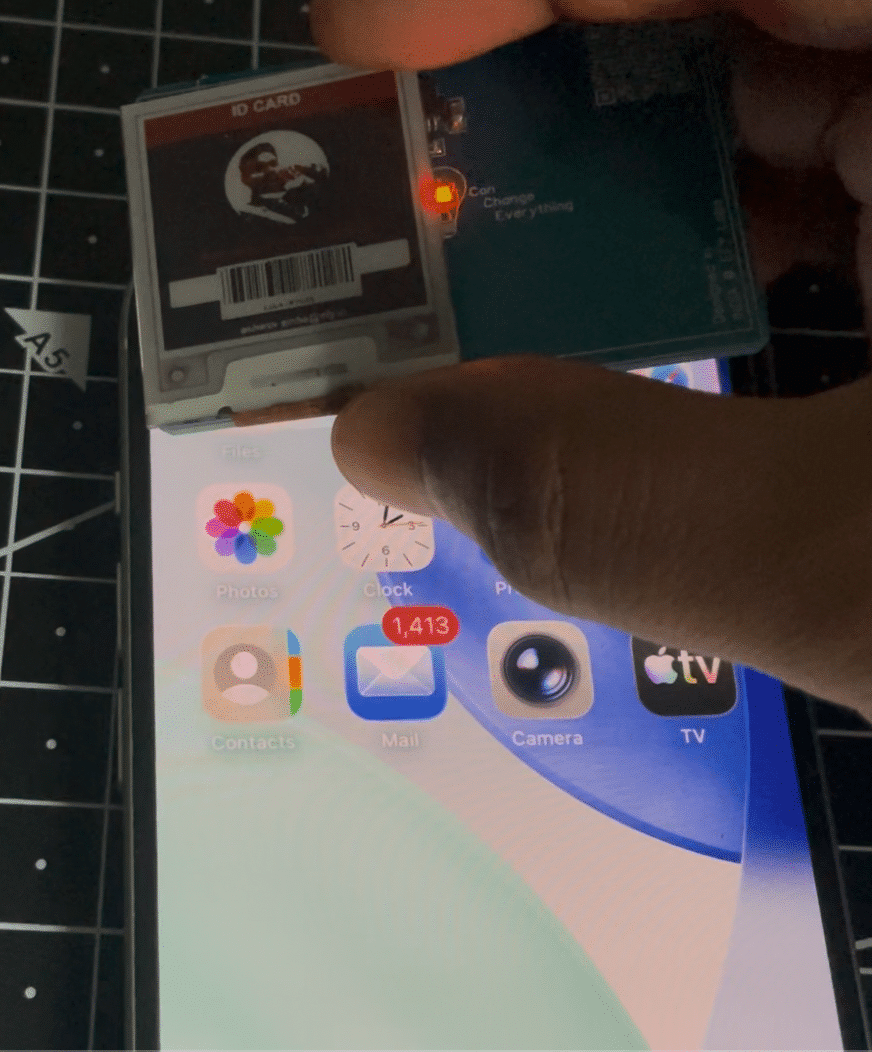
Batteryless NFC ID cards are widely used across various sectors for applications such as secure entry at gates, employee attendance, and student access control. Traditional plastic NFC ID cards, however, require complete reprinting and reissuing whenever details such as name, photo, designation, or validity need to be updated.
A new generation of smart NFC cards combines EPD (E-Paper or E-Ink Display) technology with batteryless operation. These cards can update both the visual information displayed on the EPD and the digital data stored in the NFC chip without replacing the card.
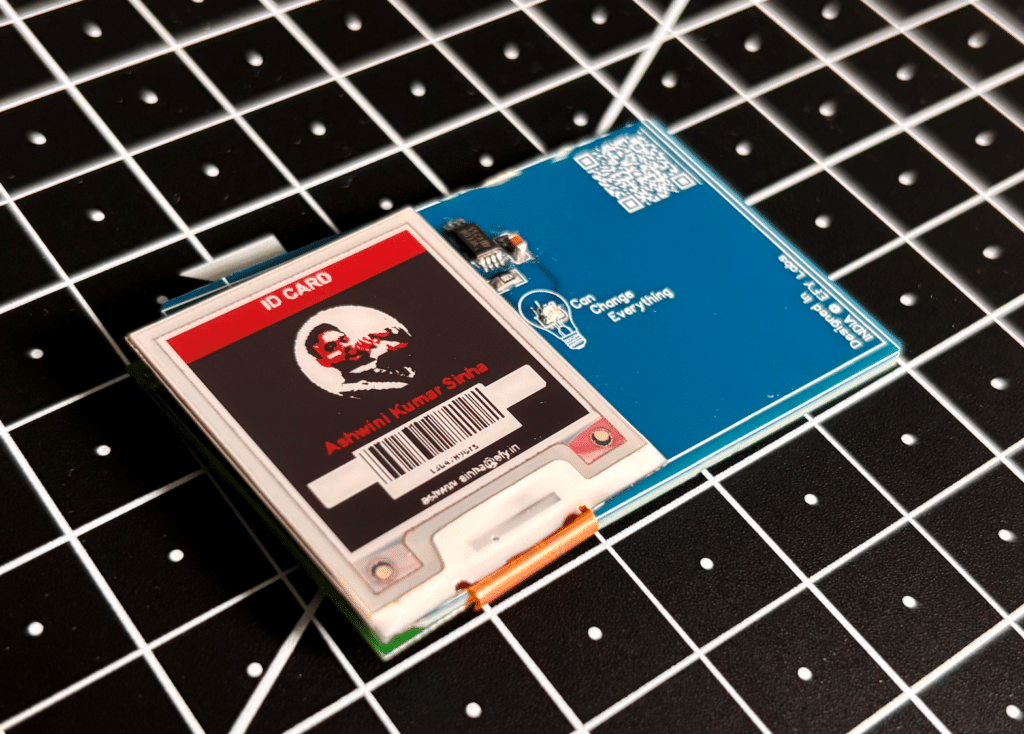
This design demonstrates a similar Batteryless Smart NFC ID Card using an E-Paper Display combined with an NFC energy harvesting module. This setup enables the card display and stored information to be updated using only the energy harvested from an NFC reader or smartphone, eliminating the need for a battery.
The PCB also includes a powerful NFC chip, the ST25DV64K-IER6T3, which supports password protection and secure data storage. The chip can store employee or student data and harvest energy during an NFC scan. The harvested energy can also be used for additional functions such as blinking an LED during a scan, displaying short messages, or logging scan events.
Overall, the system is batteryless, energy-efficient, and reduces the need for reprinting ID cards. Information can be updated by authorised personnel, helping maintain data integrity and security.
Also check: DIY batteryless NFC business card.
Bill of material
Several NFC ICs with energy harvesting capabilities are available on the market. The ST25DV64K-IER6T3 IC is used in the current design
| ID | Name | Designator | Footprint | Quantity | Manufacturer Part | Manufacturer |
| 1 | 10uF | C1 | C0805 | 1 | CL10A106KP8NNNC | SAMSUNG |
| 2 | NFC-D3-029 E-INK Module | R1 | NFC E-paper Driver Module | 1 | NFC-D3-029 | Good-Display |
| 3 | GDEY0266F51 E-Paper/ E-Ink Display | SPI E-ink Display | 1 | GDEY0266F51 | Good-Display | |
| 4 | 2.7 KΩ | R1 | R0805 | 1 | 0805W8F2701T5E | UNI-ROYAL |
| 5 | KP-1608SURCK | U2 | LED0603-RD_RED | 1 | KP-1608SURCK | Kingbright |
| 6 | ST25DV64K-IER6T3 | U4 | TSSOP-8_L4.4-W3.0-P0.65-LS6.4-BL | 1 | ST25DV64K-IER6T3 | ST |
Designing Batteryless NFC ID Card
The design consists of two main functions:
- E-Ink Display: Shows the photo, text, barcode, and other identification details.
- NFC Chip: Stores the information and shares it with a reader device whenever the card is scanned.
All components, from the display to the NFC storage and communication circuitry, operate without a battery and can use energy harvested from the NFC field.
The display size can be selected according to the application. Various sizes of E-Ink displays are available on the market. The current design uses the GDEY0266F51 2.66-inch multicolour E-Ink display, which is suitable for displaying photos and detailed information.
A separate NFC module is used to update the E-Ink display. Once the display is updated, it can be mounted on the main NFC chip PCB to form the complete ID card. The main NFC chip can then be used for storing and sharing personal data during scanning. It can also power a small LED during an NFC scan using harvested energy.
NFC Energy Harvesting Main Card
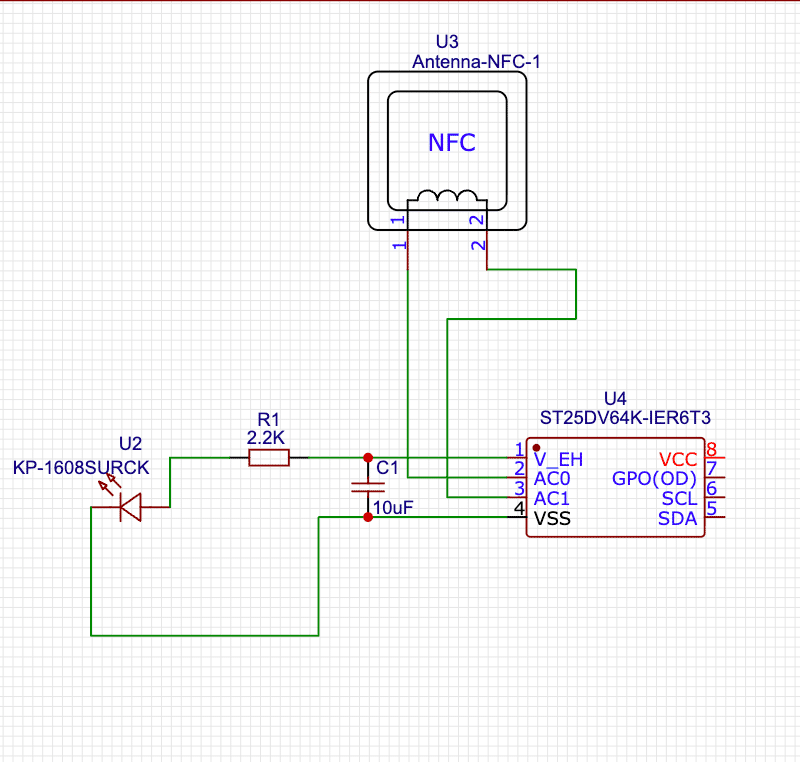
According to the IC datasheet, the ST25DV64K-IER6T3 supports energy harvesting and provides the harvested energy output through the V_EH pin (refer to Fig. 2 for the IC pinout). The IC also supports FTM (Fast Transfer Mode), which can be used for fast data transfer and storage of personal details, entry and exit logs, and other information.
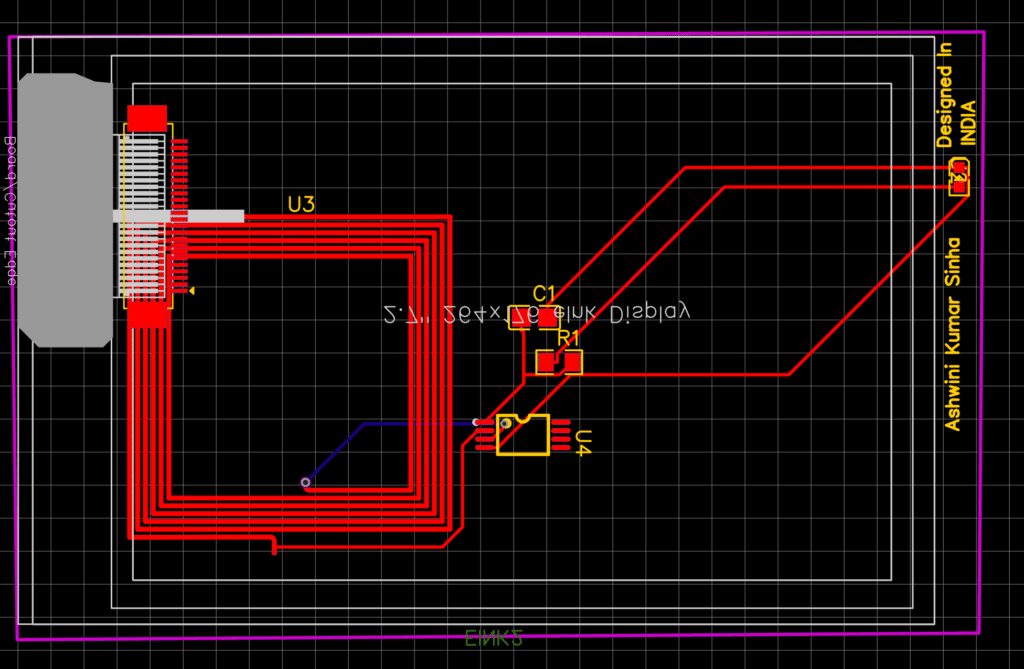
In the schematic (refer to Fig. 2), the ST25DV64K-IER6T3 (U4) is directly connected to the NFC antenna coil (U3) through the AC0 and AC1 pins. The energy harvesting output (V_EH, Pin 1) powers a KP-1608SURCK hyper-red LED through a 2.2kΩ current-limiting resistor (R1). A 10µF capacitor (C1) is connected between V_EH and GND to improve voltage stability during variations in the RF field.
VSS provides the ground reference, while VCC (Pin 8) can be left open or optionally connected for external programming. The GPO pin, which is an open-drain output, can be used for future interrupt functions.
This simple circuit allows the LED to faintly illuminate when the card is tapped with an NFC-enabled phone, demonstrating the energy harvesting capability of the IC. The harvested power depends on factors such as the NFC reader, antenna design, coupling, and distance between the card and reader.
Antenna design
Antenna design is one of the most critical parts of an NFC card, particularly when good read range and sufficient energy harvesting are required for powering additional functions such as an LED. A poorly designed antenna can result in a short read range and insufficient harvested power, causing the LED to remain off or appear very dim.
The target is to design an antenna with an inductance of approximately 2.8µH to 3.3µH, suitable for the selected IC and an operating frequency of around 13.56MHz. Various free tools and calculators are available for NFC antenna design and simulation from manufacturers such as NXP and ST. The appropriate tool can be selected based on the NFC IC being used, as these tools are often optimised for specific ICs and applications.
The ST antenna design tool is used in the current design. The required parameters are entered into the tool to achieve the target inductance. The track width and gap parameters are selected according to the calculated antenna specifications (refer to Fig. 4).
The design uses a multi-turn rectangular spiral coil with concentric loops, which is a common approach for NFC antennas. The antenna is sized to fit within the form factor of an ID or business card.
The following parameters are used:
- Number of turns: 6–7
- Length: 33–34mm
- Width: 33mm
- Spacing: 0.29mm
- Copper thickness: 35µm
The target is to achieve a total inductance of approximately 3µH using the ST antenna design tool.
After calculating the antenna parameters, the antenna is designed in the PCB layout using the same specifications entered into the NFC antenna design tool. This helps achieve the required inductance for NFC communication and energy harvesting.
The PCB can then be manufactured and populated with the required SMD components.
Updating the display
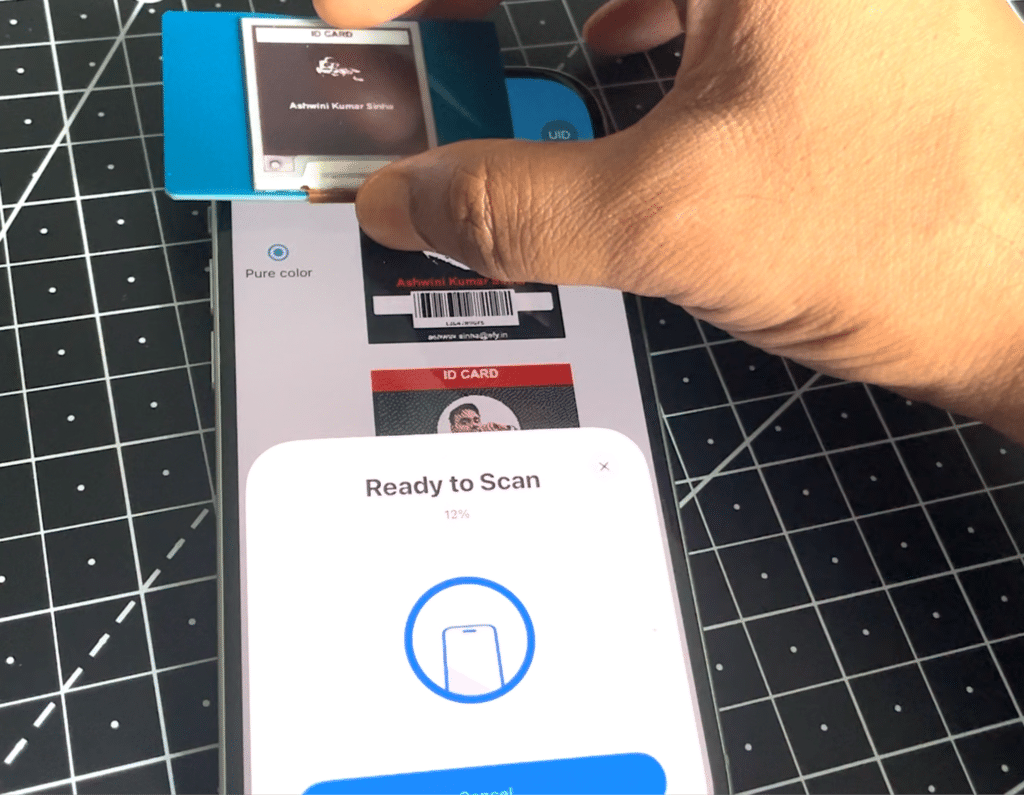
The NFC energy harvesting module is connected to the E-Paper display. An eTag app or the recommended display programming application can then be installed on an NFC-enabled smartphone.
The required ID card image, including the barcode, name, designation, and other details, is selected in the application. When the card is tapped against the smartphone, the image is transferred to the E-Paper display and updated.
Important Feature: The display does not require a battery for updating. It harvests energy directly from the NFC field during the tap and uses the harvested energy to update the screen content.
Programming the NFC Chip
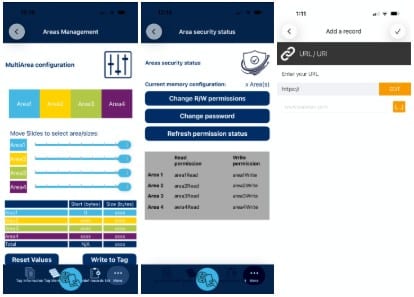
The NFC Tools app and the official programming application for the selected NFC IC can be used to configure the NFC chip. The current design uses the ST25DV64K-IER6T3, which can be configured using the NFC Tap application.
The card is placed near the NFC antenna of a smartphone. When the card is tapped, the smartphone reads the NFC chip and displays the stored information. On an iPhone, the NFC antenna is generally located near the top of the device.
The storage area can then be configured as required. A password can also be configured for read and write protection to prevent unauthorised access and modification of the stored information.
The required information can then be written to the card. Depending on the application, the NFC memory can store text, files, URLs, unique identification numbers, and other data. Multiple memory blocks are available for configuring different types of information.
When the card is scanned, the stored information can be read by a compatible NFC reader and used for applications such as identification, access control, or data sharing.
Testing Batteryless NFC ID Card
Once the card is configured, it can be scanned using a compatible NFC reader. The stored information is shared with the reader, while the LED on the card can also blink using the harvested energy from the NFC field.
The same concept can be adapted for various applications, including smart entry and exit systems, access-control systems, automobile door locks, hotel door locks, employee identification, and university student ID cards.