




This reference design provides a complete, production-ready blueprint for developing immersive audio systems, allowing engineers to accelerate development while achieving professional-grade audio quality in consumer-grade devices.
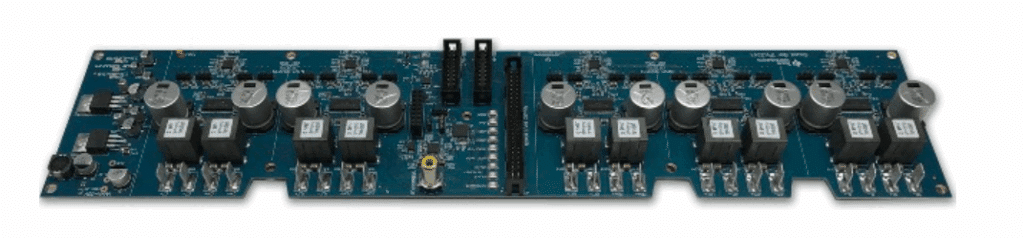
For design engineers working on audio systems, especially in the consumer electronics space, a well-architected reference design can save significant time and effort. This particular reference design offers a compact yet powerful solution for creating immersive, high-performance audio experiences in applications like soundbars, home theaters, and AV receivers. It demonstrates how to integrate Texas Instruments’ latest audio components into a single, streamlined 5.1.2 Dolby Atmos® soundbar system — making it an invaluable resource for engineers building modern, space-efficient audio systems with premium sound quality.
At the core of this design TIDA-01414 is the combination of Texas Instrument’s (TI) high-performance TPA3244 Class-D amplifier and PCM5252 DAC with integrated DSP, alongside the 66AK2G system-on-chip (SoC) that handles Dolby Atmos decoding and rendering. Together, these components support a 5.1.2 channel setup, delivering ultra-HD, three-dimensional sound from a small form-factor (SFF) design. The TPA3244 enables ten Class-D amplifier channels operating in bridge-tied load (BTL) mode, each capable of delivering up to 110W RMS peaks without requiring a heatsink — ideal for compact enclosures.
The PCM5252 DAC with Burr-Brown lineage not only converts digital signals to analog but also incorporates advanced digital signal processing capabilities. These include active crossovers, digital room correction (DRC), and customizable biquads, which eliminate the need for passive crossovers and allow fine-tuning of frequency response between woofer and tweeter. SmartBass enhancement extends the low-end frequency response, enabling designers to either boost performance or eliminate the need for a dedicated subwoofer.
This reference design also ensures seamless digital input compatibility via HDMI, Bluetooth, or other AV connectors, feeding an I2S signal into the audio chain. The Dolby Atmos decoding SoC supports a wide dynamic range, making it suitable for high-end audio applications that demand both fidelity and efficiency. Applications for this design range from premium soundbars and AV receivers to more affordable home theater-in-a-box (HTiB) systems. AVRs benefit from the design’s low distortion, high output power, and superior SNR, while HTiBs leverage its compactness and integrated processing for an optimized cost-performance balance.
TI has tested this reference design. It comes with a bill of materials (BOM), schematics, assembly drawing, printed circuit board (PCB) layout, and more. The company’s website has additional data about the reference design. To read more about this reference design, click here.