





Arc faults can pose a serious threat to electrical safety, but detecting them can be challenging. This reference design integrates fast current sensing, voltage monitoring, and AI-powered detection to simplify development for circuit breakers.
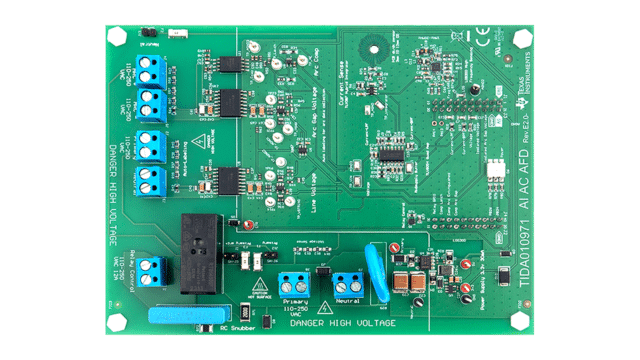
Residential and commercial circuit breakers face three major challenges: detecting arc faults reliably, reducing false trips and speeding up product development. Arc faults generate high-frequency currents that standard breakers can easily miss, making early detection difficult. Traditional arc fault detection methods rely on simple analog filters, which may overlook fast transient events or misinterpret normal line disturbances as faults. This often forces repeated prototyping and testing, increasing both development time and cost.
To address these challenges, Texas Instruments has introduced an AC arc fault detection reference design, a modular platform that integrates fast current sensing, voltage monitoring, analog signal conditioning and AI-powered detection in a single system. By combining these elements, the design captures rapid arcing events more accurately while minimizing false positives. Its modular approach also allows engineers to adapt the platform to different line voltages, current ratings and breaker types, reducing the need to start development from scratch.
The system starts with sensitive Rogowski coil current sensors that measure branch currents and detect the rapid transients caused by arcs. Their differential setup helps reject noise while ensuring even short-duration arcs are captured. The current signal is then amplified through a precision integrator circuit, preserving low-level signals without distortion. It passes through a band-pass filter that isolates arcing frequencies and a low-pass filter for normal line current, creating a clean, ready-to-process signal. These filtered signals are converted into voltage levels suitable for the microcontroller while maintaining the full range of transient events.
Voltage monitoring is handled by isolated sensors that track both line voltage and potential arc-gap voltage. This allows the embedded AI to correlate current and voltage patterns, improving accuracy and reducing false positives. The microcontroller continuously analyzes these digitized signals, running an AI detection algorithm in real time. When an arc is detected, a trip signal is generated. The platform also includes test circuits, enabling engineers to simulate arcs and validate detection performance without risking equipment or safety.
Power is provided through a compact switching regulator and low-dropout linear supply, giving stable rails for both analog and digital circuits. Thermal and electrical isolation are built into the PCB layout to maintain safety under high-voltage operation. The modular design means the same system can be applied to different line voltages, current ratings and breaker types, reducing development time and prototyping cycles.
By combining high-speed sensing, signal conditioning, AI processing and safe power management in one reference platform, this design makes arc fault detection easier and more reliable. Engineers can reuse the architecture across multiple breaker designs, cutting development effort while meeting safety standards. The scalable, modular approach ensures that manufacturers can quickly implement advanced arc fault detection in a variety of applications, improving both system reliability and user safety.To read more about this reference design, click here.
