Measuring current precisely without design headaches is possible. Discover a compact reference design that simplifies sensing up to 30 A while ensuring industrial reliability.
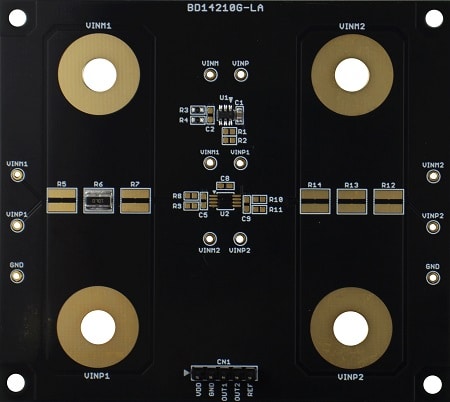
When we design circuits, one of the constant challenges is measuring current accurately. You know how tricky it can get with offset errors, bias currents, or mismatched gain resistors that quickly throw off results. On top of that, we often have to balance accuracy with board space and still make sure the design will be reliable for years in industrial use. That is where this reference design can help us. It is meant to take away those pain points so we can focus on the bigger system design.
REFSENSE003, a reference design from ROHM combines a current sense amplifier with a shunt resistor in a ready-to-use design. With it, we can handle current measurement in different scenarios such as high-side or low-side sensing, motor current control, or overcurrent detection. Since the amplifier and shunt are already paired and tested, we save the effort of trial and error in component selection and circuit tuning.
The design prioritizes precision and simplicity. It achieves 1% current sense accuracy and supports measurements up to 30 A. We can easily connect it to an AD converter for further processing or integration into larger control systems. The compact layout helps save board space, which is valuable when designing industrial or space-constrained applications.
For engineers working on long-term projects, the current sense amplifier is designed for reliability. It operates from a single 2.7 V to 5.5 V power supply and handles a wide common-mode voltage range of -0.2 V to +26 V. The matched gain resistor ensures low gain error and offset voltage, and the input bias current is minimal at around 1 μA. This makes implementation straightforward and reduces the need for calibration or complex circuit adjustments.
The amplifier offers several key advantages that matter in industrial use. Long-term support ensures reliability and availability over the lifetime of a product. A wide common-mode voltage range allows it to handle a variety of voltage conditions in different circuit configurations. High accuracy is critical for precise current measurement and control, and low offset voltage helps maintain precision under varying operating conditions. Low input bias current minimizes errors and simplifies integration into current sensing circuits.
The company claims that the design gives us a ready-to-use solution for precise current measurement. Its high accuracy, broad operating range, and industrial-grade design make it easier for us to design reliable and efficient circuits without spending extra time on trial-and-error testing or redesigns.
ROHM has tested this reference design. It comes with a bill of materials (BOM), schematics, assembly drawing, printed circuit board (PCB) layout, and more. The company’s website has additional data about the reference design. To read more about this reference design, click here.