




What if a doorbell never needed a battery and still sent signals wirelessly over long distances. This design can turn every button press into power.
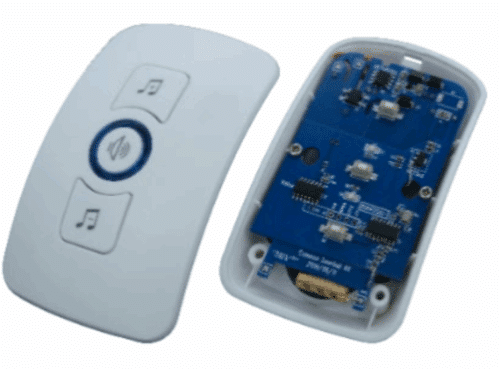
Wireless doorbells often face two major problems. They require frequent battery replacements and need to fit into compact, space-constrained designs. Holtek’s Sub-1GHz self-powered doorbell solution solves both problems by combining the transmitter and the receiver MCU to create a battery-free OOK RF link operating below 1GHz at 315, 433, 868, and 915MHz. This allows the doorbell to provide a wireless bell ring or alarm function without relying on a transmitter battery.
The transmitter converts the kinetic energy from pressing the push button into electrical energy. Each press generates 600µJ, which is enough to power the low-power RF device, and the push button can be pressed more than 200,000 times. This design eliminates the need for battery maintenance and provides a more environmentally friendly approach for long-term use.
The receiver MCU is a Sub-1GHz OOK and GFSK transmitter with an integrated encoder. It supports multiple data formats, including 1527, HT6P20B, and custom formats, and can deliver transmission power up to +13dBm. The transmitter requires only an external crystal and minimal additional components to create a complete universal RF transmitter. It also provides an I2C interface and internal FUSE data memory that can be programmed for flexible operation. This integration simplifies control and reduces the component count, making it easier for engineers to implement a reliable wireless transmitter.
The receiver MCU is a high-performance low-IF OOK RF receiver Flash MCU. Its integrated RF receiver features an automatic gain control unit and a fully integrated OOK demodulator. It operates across the 315, 433, 868, and 915MHz bands, consumes only 3.2mA at 433MHz, and achieves high sensitivity of -106dBm with data rates from 1Ksps to 10Ksps. This combination of low power consumption, high sensitivity, and simplified circuitry makes it ideal for doorbell applications and other low-power wireless systems.
In operation, pressing the transmitter button generates energy that powers the RF device to encode and modulate data onto an RF signal. The receiver decodes the transmitted signal and triggers a bell, ringtone, or alarm. Self-powered wireless doorbells consist of a transmitter and receiver. The transmitter uses the transmitter MCU to send the RF signal, and the receiver uses the receiver MCU to decode it and trigger actions. Both components are optimized for low-power, compact design, and reliable operation, providing a battery-free wireless doorbell solution that is easy to integrate and maintain.
Holtek has tested this reference design. It comes with a bill of materials (BOM), schematics, assembly drawing, printed circuit board (PCB) layout, and more. The company’s website has additional data about the reference design. To read more about this reference design, click here.