From failed attempts to smart solutions, three friends turn hardware problems into a robotics kit. This could be the future path to learn AI and ML for school students as well as professionals.
In 2022, three college friends—Hitendra, Bhagyesh, and Guru—decided to start something new. Fascinated by robotics, especially autonomous robot navigation, they initially aimed to build indigenous industrial and customer-oriented robots to support industries in India. As they worked on their projects, they realised the real opportunity was in education, not just industrial applications.
This year, in 2025, they registered their company as Ecruxbot Private Limited and shifted focus towards helping students learn robotics and advanced technologies. Their first product, Adhyay, is an educational kit designed for flexibility. Instead of buying a new kit for every project, students can swap development boards like Arduino Nano, Raspberry Pi Pico, STM32, and ESP32 on the same custom motherboard. Adhyay allows students to begin with basic LED control and scale up to TinyML, IoT, and AI, running models directly on hardware with built-in sensors, Wi-Fi, and Bluetooth.
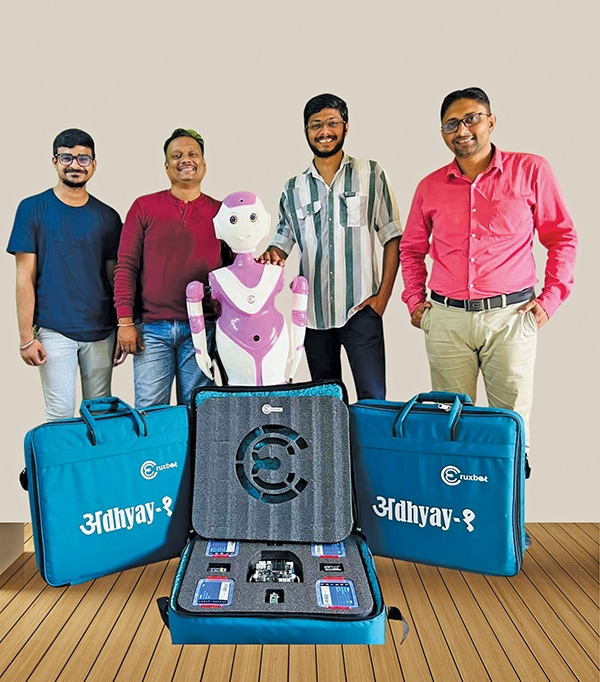
What makes it unique and how it helps its target users? Hitendra explains, “ESP32 supports both Arduino IDE and ESP-IDF coding. We included STM32 as an entry-level industrial controller, so when students list experience with Arduino, ESP, STM, and Raspberry Pi on their résumé, it stands out. Plus, we offer a full open source learning management system with videos, lectures, and courses. Basic and intermediate courses are free, while advanced AI-focused videos are paid and created in-house.”
Designing the kit involved many technical hurdles. After five iterations, solving impedance, memory, and buffer issues through forums, mentors, and trial and error, the final kit was stabilised and refined through student workshops.

While discussing the integration of AI and ML, Bhagyesh adds, “We had to create our own mathematical library, building functions that run directly on the microcontroller. The first challenge was essentially recreating NumPy in a much simpler form, and it is still being improved for wider TinyML use. Apart from library issues, hardware limitations were a major problem. Unlike laptops or computers, microcontrollers have very limited RAM, and sensor data often comes in inconsistent formats, making it difficult to use for model training.”
While discussing revenue, Hitendra says, “The company was registered as a Private Limited in March 2025 and has provided Robotics and AI labs to about 50 schools and colleges since then.”
Though Adhyay emerged as a by-product of their bootstrapped startup, their long-term aim remains building robots for industry, similar to Tesla’s autonomous navigation cars.
Currently, they are developing Arya, a receptionist robot with AI. Arya will include machine learning, image and voice recognition, and interactive conversation capability. Orders are already in place, but delivery will follow once development is complete. This reflects their vision of advancing industrial robotics alongside education products.
Hitendra Valhe and Bhagyesh Tajne share Ecruxbot’s story with EFY.