A new 3D printing technology breakthrough could reshape how complex aerospace components are built, improving speed, flexibility, and efficiency.
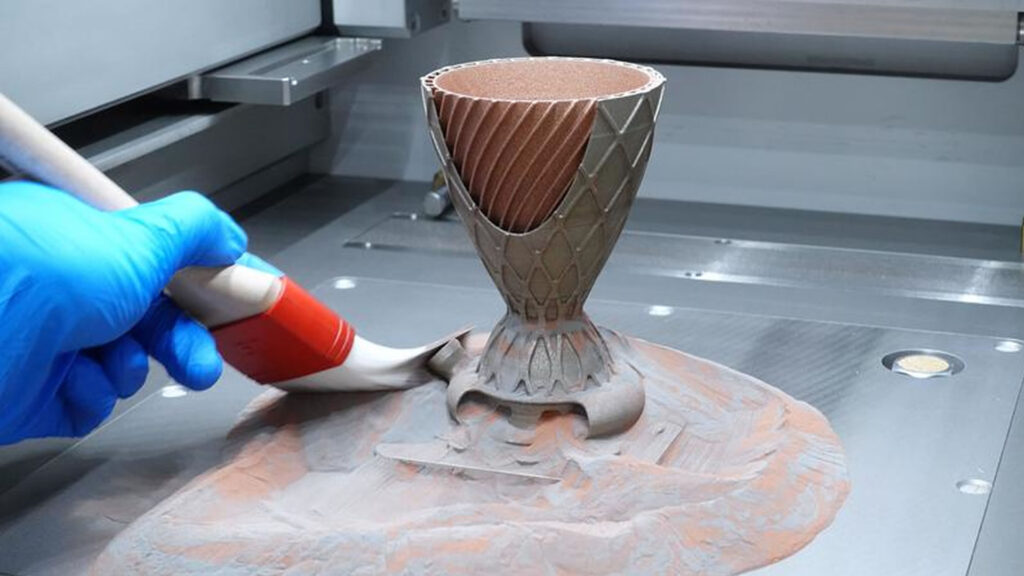
Researchers at the Fraunhofer Institute for Casting, Composite and Processing Technology have developed an advanced 3D-printing method that could transform how critical rocket components are manufactured. Unlike conventional approaches, this new technique allows multiple metals to be combined within a single print, enabling complex parts to be produced in one step instead of being assembled from many individual pieces.
By simplifying manufacturing, the process could support the development of lighter, more compact rocket engines with improved performance, strengthening Europe’s ability to independently produce launch systems such as Ariane 6 and future designs.
Rocket engines are among the most complex machines ever built, typically requiring numerous parts made from different metals. These components must be individually machined, tested, and then welded or bonded together, making the process both expensive and time-consuming. Each joint also introduces a potential point of failure. The new additive manufacturing method addresses these challenges by enabling engineers to print integrated components in a single run, significantly reducing assembly steps.
A key advantage of this approach is the ability to strategically place different metals within a component. Engineers can incorporate heat-resistant materials where temperatures are highest, stronger alloys in high-stress areas, magnetic materials where control is needed, and lighter metals where possible. In one demonstration, the team successfully printed a rocket valve using both magnetic and non-magnetic steel in a single process. It is something that would traditionally require multiple manufacturing stages.
However, combining metals is technically challenging, as some materials react poorly when joined. For instance, titanium and nickel can form brittle structures. To overcome this, the researchers introduced a thin layer of molybdenum between incompatible metals, preventing structural weaknesses.
While private companies like SpaceX are already using 3D printing, this breakthrough helps public European programs catch up. It lays the groundwork for faster, more flexible, and scalable rocket production in the future.