




Researchers at Tokyo University of Science have developed a machine learning model to predict electrode materials for sodium-ion batteries for applications like grid storage.
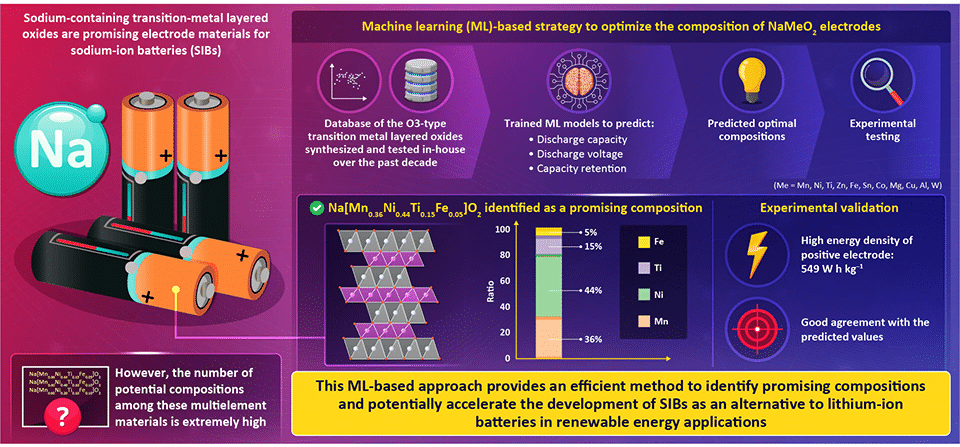
Sodium-ion batteries predicted by a research team of Tokyo University of Science, Japan are appealing for their lower cost, but their larger sodium ions are challenging to store efficiently. To address this, the research focused on transition-metal layered oxides, specifically in the NaMeO₂ form, where ‘Me’ represents a mix of metals like manganese, nickel, titanium, and iron. These materials, described as powerful for sodium-ion battery positive electrodes, offer high energy density and capacity. However, determining the ideal composition from many metal combinations is complex and time-consuming, as even slight changes in metal ratios can significantly impact crystal structure and battery performance. This advancement is likely to capture the interest of energy storage manufacturers, sustainable energy advocates, and researchers focused on developing affordable battery solutions.
Using 11 years of raw experimental data, encompassing 68 unique compositions and 100 charge-discharge tests, the AI model was trained to predict key battery performance metrics, such as discharge voltage and capacity retention. Through algorithms and Bayesian optimization, the machine learning system was able to establish relationships between these parameters and metal composition, ultimately pinpointing specific ratios that could optimize voltage, lifespan, and energy density.
The model’s top prediction, Na(Mn₀.₃₆Ni₀.₄₄Ti₀.₁₅Fe₀.₀₅)O₂, demonstrated high energy density in laboratory tests, affirming the AI’s accuracy. “The measured values were, for the most part, consistent with the predicted ones, highlighting the accuracy of the model and its potential for exploring new battery materials,” said the university. The findings showcase how AI can expedite the discovery of optimized materials for energy storage solutions.
Tokyo University of Science collaborated with Chalmers University of Technology and Nagoya Institute of Technology on this study. The study offers detailed insights into the machine learning methods and electrochemical findings, marking a significant step towards advancing cost-effective, high-performance sodium-ion batteries for sustainable energy applications.


