




Arduino has released version 1.0.0 of its Zephyr-based core, adding support for the VENTUNO Q, Nicla Vision camera capture and eleven boards in total.
Arduino has released Arduino Core on Zephyr 1.0.0, the first stable version of its Arduino core built on the Zephyr real-time operating system (RTOS). Released on September 3, 2026, the update is based on Zephyr 4.4.1 and follows version 0.90.0, which focused on stabilising the core.
Traditional Arduino sketches generally follow a simple execution model: setup() runs once, followed by loop() running repeatedly, with interrupts handling time-critical events. Zephyr adds a preemptive RTOS underneath the familiar Arduino application programming interface (API), providing features such as threads, timers, a structured device-driver model and power management while allowing developers to continue using the Arduino programming model.
Arduino Core on Zephyr 1.0.0 supports 11 boards: UNO Q, VENTUNO Q, Portenta H7, Portenta C33, Opta microPLC, GIGA R1 WiFi, Nano Matter, Nano RP2040 Connect, Nano 33 BLE, Nicla Sense ME and Nicla Vision.
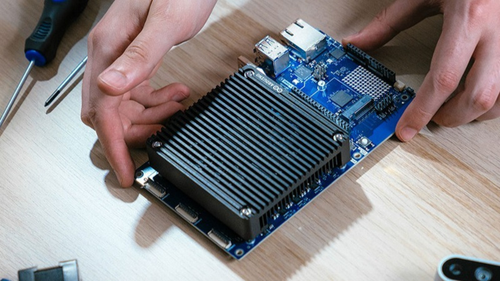
VENTUNO Q is newly supported in this release. Arduino says its Zephyr integration enables deterministic real-time control on the board’s STM32 microcontroller. Nicla Vision also gains camera support, enabling on-device vision applications such as object detection and image classification.
Two major capabilities underpin the move to Zephyr. The first is real-time scheduling. Traditional Arduino sketches generally run within a single loop() execution model, whereas Zephyr provides preemptive threads and priority-based scheduling for applications that need more structured timing and concurrency.
The second is Zephyr’s broader upstream software and driver ecosystem. Arduino Core on Zephyr 1.0.0 is based on Zephyr 4.4.1, bringing upstream improvements, security fixes and expanded driver support to the supported boards. Arduino also says the release includes substantial bug fixes and internal cleanup aimed at improving stability and consistency.
The core ships under the Apache-2.0 licence for its Zephyr-specific implementation. For normal users, no separate Zephyr toolchain setup is required: Arduino says the core and its required toolchains can be installed through the Arduino IDE Boards Manager by searching for “Zephyr.”
Engineers who needed RTOS features on Arduino-class hardware previously often had to move to vendor software frameworks or work directly with an RTOS, giving up some of the simplicity of the Arduino sketch workflow. Arduino Core on Zephyr takes a different approach by keeping the familiar Arduino API and programming model while placing the Zephyr kernel underneath it. For students and small engineering teams, this could make real-time features more accessible without requiring a complete shift to a different development environment.
This is a production software release rather than a preview. The significance is in the version number: version 0.90.0 focused on stabilising the project, while 1.0.0 marks the first release Arduino considers stable.
India has a large engineering education ecosystem where Arduino boards are widely used for embedded systems teaching and prototyping. That makes Arduino Core on Zephyr potentially relevant beyond hobby projects. Zephyr is also used in professional embedded development, so the release could give students and small engineering teams exposure to concepts such as real-time scheduling, device configuration and RTOS-based development while retaining the familiar Arduino programming model.
The practical advantage is that the software can be installed through the Arduino IDE’s Boards Manager, and several already supported boards can run the Zephyr-based core. This means institutions and developers with compatible hardware may be able to experiment with the platform without purchasing newly released boards.
For newer hardware such as the UNO Q and VENTUNO Q, Indian pricing and availability may be more significant factors in adoption. The software itself, however, does not require users to purchase those new boards simply to experiment with Arduino Core on Zephyr.
India teaches embedded systems using platforms such as Arduino, while industry increasingly values RTOS experience. This release could help narrow the gap between the two.
For more information, click here.

