





A developer has reverse-engineered the LC75826W display controller in a scrapped Sony CDX-A250 head unit and released MIT-licensed Arduino code that lets makers reuse its segment LCD in new projects.
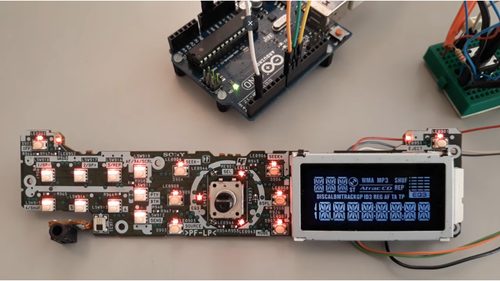
A salvaged Sony CDX-A250 car stereo can provide more than spare buttons and mechanical parts. Its front panel contains a custom segment LCD driven by an LC75826W controller, and developer Jose Luis Monteiro, who publishes as emsyscode, has reverse-engineered the interface to drive the panel independently using an Arduino. The project provides the required firmware and segment-mapping information for turning the old display into a reusable component.
The LC75826W is a segment LCD driver controlled through Sanyo’s CCB (Computer Control Bus) serial interface. The Arduino communicates with the driver using three main signals: CE, CL and DI. In the reference setup, Arduino D8 connects to the LCD data line, D9 to the clock line and D10 to chip enable. The Sony panel exposes these signals as DATA-LCD, CLOCK-LCD and CE-LCD respectively.
The hardware consists of a salvaged Sony CDX-A250 front panel, an Arduino-compatible board, suitable wiring and the required power connections for the panel. The original project also uses a pushbutton connected to an Arduino input to step through the segment-identification routine. Care is required when powering the salvaged assembly because the panel’s supply arrangement should not be confused with the operating voltage required by the LC75826W itself.
Once the connections are established, the Arduino communicates with the LC75826W using the CCB protocol. Display information is transferred to the controller in groups, with the device’s data fields determining which outputs are driven. The controller provides numerous display-data positions, allowing the software to address individual segments rather than treating the LCD as a conventional character display.

This is important because the LCD glass does not behave like a ready-made character module. The LC75826W controls electrical segment outputs, but the software needs to determine which output corresponds to each visible number, letter or icon on Sony’s custom glass. The reverse-engineering process therefore involves sending test patterns to the display and recording which physical segments respond. These results can then be used to create a segment table for displaying custom information.
The project demonstrates this process with the CDX-A250 panel, allowing the Arduino to take control of individual display elements rather than simply reproducing the original car stereo’s interface. Once the segment relationships are understood, the same approach can be used to create custom display patterns for applications such as clocks, counters, meters and equipment status indicators.
The full project is released under the MIT licence and includes the Arduino implementation, connection information, protocol details, segment-mapping guidance and a video walkthrough. It is deliberately designed around the Sony CDX-A250 rather than presented as a universal LC75826W software library. This makes the project useful as a reference for developers interested in reverse-engineering similar salvaged displays.
That limitation is important when reusing other car-stereo panels. Even if another head unit uses the same LC75826W controller, its LCD glass may connect the controller outputs to different visible segments and icons. Such a panel would therefore require its own mapping and corresponding software changes.
For repair enthusiasts and makers, the approach provides a practical way to reuse hardware that might otherwise become electronic waste. Old car stereos can provide usable displays for new projects without requiring a new display module to be purchased. By identifying the controller, understanding its communication protocol and mapping the display segments, an otherwise obsolete automotive component can become a programmable display for a new embedded project.
For more information, click here.


