China tests flexible robotic arm on satellite to enable precise on-orbit servicing, refueling, and future autonomous space maintenance operations.
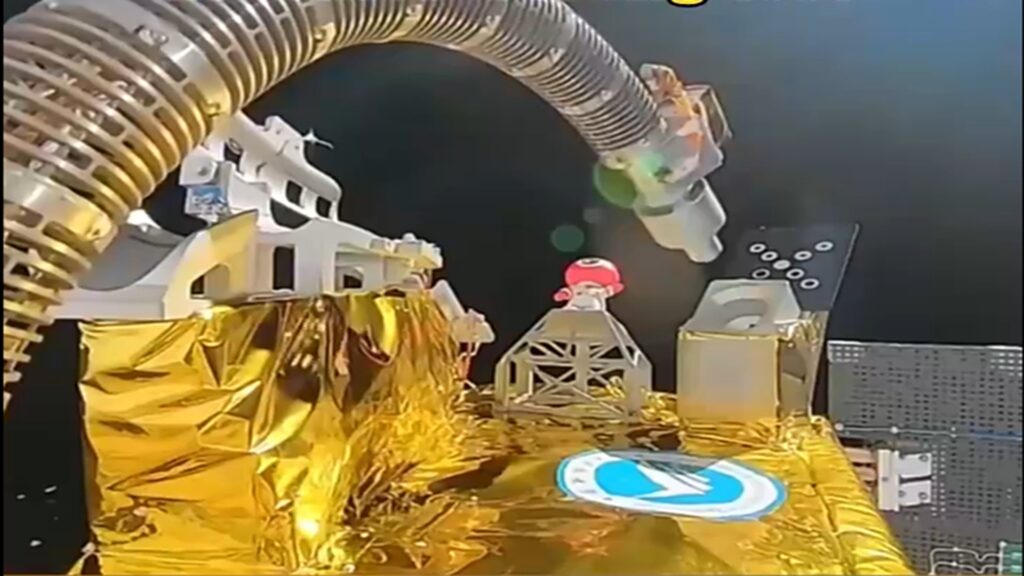
China has achieved a significant milestone in space technology with the successful testing of a highly flexible robotic arm aboard a commercial satellite. The mission marks an important step toward enabling autonomous on-orbit servicing, maintenance, and refueling of spacecraft in the future.
The satellite, Yuxing-3 06 (also known as Xiyuan-0), was launched on March 16, 2026, from the Jiuquan Satellite Launch Center using a Kuaizhou-11 rocket. Once in orbit, it carried out a series of experiments to test the capabilities of its primary payload, a flexible continuum robotic arm developed by Suzhou Sanyuan Aerospace Technology Co., Ltd. in collaboration with Tsinghua University Shenzhen International Graduate School. The satellite platform itself was built by Shenzhen Mofang Satellite Technology Co., Ltd..
During the mission, engineers evaluated the robotic arm through four distinct operational modes designed to simulate real-world servicing scenarios. In the first mode, the arm autonomously performed a programmed refueling simulation, moving between safe and docking positions without human intervention, demonstrating reliable onboard motion planning and execution.
The second mode involved remote-controlled operations, where ground operators guided the arm in real time using camera feedback. This human-in-the-loop approach is crucial for handling unpredictable or non-cooperative targets in space.
In the third mode, visual servo docking, the system used camera imagery to determine the arm’s position and adjust its movements accordingly. This enabled precise, vision-based control through continuous communication between ground systems and the satellite.
The fourth mode focused on force-compliant manipulation. Using real-time sensor data, the arm performed controlled drawing tasks, verifying its ability to apply precise force, an essential requirement for delicate operations.
The robotic arm features a flexible, lightweight design combined with a cable-driven mechanism housed within the satellite, improving durability while reducing complexity and cost. Its compatibility with flexible fuel pipelines also enhances safety for future refueling missions.
Supported by a global ground station network, the mission maintained stable communication with minimal delay, ensuring smooth coordination between space and ground. Overall, the successful tests represent a major advancement in China’s commercial space servicing capabilities.