





Chinese researchers have unveiled a carbon-14 nuclear battery capable of operating for thousands of years, targeting spacecraft, remote sensors and long-life industrial applications.
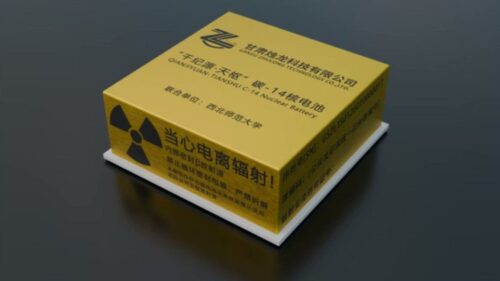
Researchers at Northwest Normal University and Gansu Zhulong Technology have developed a new-generation carbon-14 nuclear battery that could operate for thousands of years without recharging. The device uses the radioactive decay of carbon-14 together with a silicon carbide semiconductor to generate electricity directly, offering a significant improvement over the team’s earlier prototype.
Known as Qianjiyuan Tianshu, the battery is designed for applications requiring extremely long operational lifetimes, including spacecraft, remote environmental monitoring systems and certain medical implants. Unlike conventional batteries, which rely on chemical reactions, nuclear batteries generate electricity from the steady decay of radioactive isotopes, allowing them to function for decades or even millennia.
The researchers said the new design increases power output by up to 2.6 times while reducing radioactive material usage to just 22 per cent of the previous generation. It also incorporates a three-dimensional stacked architecture, improved radioactive source matching, integrated sensors and a micro-power management system, enabling self-powered operation in compact devices.
The battery measures slightly more than one cubic inch and uses 120 millicuries of carbon-14 to produce a current of 0.713 microamperes at 2.06 volts, with a maximum output of 1.3 microwatts. Instead of converting radioactive heat into electricity like traditional radioisotope batteries, it captures beta particles emitted during radioactive decay and converts them directly into electrical current through the silicon carbide semiconductor. Researchers estimate this approach improves volumetric power density by around fifteen-fold while reducing the battery’s size by approximately 17 per cent.
According to the research team, carbon-14’s half-life of 5,730 years gives the battery a theoretical operating lifespan measured in thousands of years. The technology builds on China’s earlier use of nuclear batteries in its Chang’e lunar missions and could support future deep-space exploration, remote sensing and specialised industrial systems where replacing batteries is impractical.
