Tiny plastic particles are everywhere but hard to see. A new method makes them visible with a test strip, showing pollution in water and soil.
Plastic pollution is a global problem affecting oceans, rivers, beaches, and living organisms. While larger plastic pieces are studied, tiny nanoplastic particles, smaller than a human hair, remain unexamined. These particles can pass through biological barriers, including skin and the blood brain barrier, posing risks to health and the environment. Detecting them has been difficult because their size makes them invisible to the naked eye, leaving gaps in understanding their impact and limiting the development of fast, reliable detection methods.
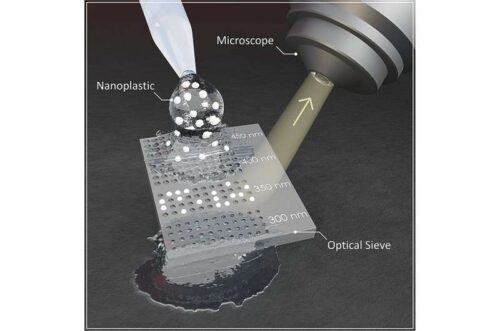
Researchers from the University of Stuttgart in Germany and the University of Melbourne in Australia have developed a method to detect nanoplastic particles. The technique uses a test strip called an optical sieve, which changes color when particles are present. This color change can be seen under a standard optical microscope, allowing scientists to count the number of particles and measure their size.
The optical sieve is made from a semiconductor substrate with holes, known as Mie voids. These holes reflect light in colors. When a nanoplastic particle enters a hole, the reflected color changes, signaling its presence. The sieve can be set to retain particles within a size range, while oversized or undersized particles are removed during cleaning. Particles between 0.2 and 1 µm can be analyzed using this method.
Tests with spherical particles in water containing components such as sand and organic matter showed that the optical sieve could measure particle size and number at concentrations of 150 µg/ml.
Compared with techniques like scanning electron microscopy, this method is less expensive, requires no trained personnel, and reduces analysis time.
The technology has applications in environmental and health research. It could be developed into test strips for on site analysis of water or soil. Future work will explore its use with non-spherical particles, its ability to differentiate types of plastics, and its effectiveness with real world water samples.