




Teledyne LeCroy’s CP1000 current probe combines 1.5 MHz bandwidth with 1000A continuous current capability for accurate testing of high-power electronic systems.
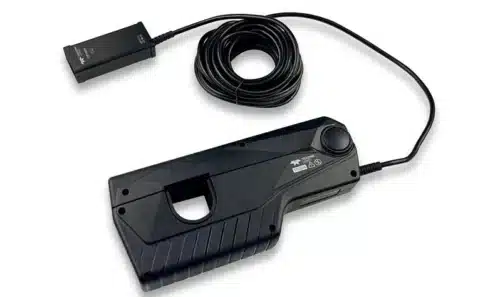
Teledyne LeCroy has introduced the CP1000 current probe, a high-performance measurement tool designed for engineers working with modern high-power electronic systems. The probe combines a 1.5 MHz bandwidth with the ability to measure up to 1000A RMS continuous current and 1400A peak current, enabling accurate analysis of both steady-state and fast-changing electrical signals.
According to the company, the CP1000 is the first current probe to offer this combination of high continuous current capability and wide bandwidth. The extended frequency response allows engineers to capture fast switching events, current spikes and high-frequency harmonics that are common in silicon carbide (SiC) and gallium nitride (GaN) power electronics. This helps improve the accuracy of switching-loss calculations, efficiency analysis and overall power-loss measurements.
The probe is intended for applications including traction inverters, electric motor drives, fast-charging stations, energy storage systems and industrial power electronics. Unlike many conventional high-current probes whose bandwidth is limited to only a few kilohertz, the CP1000 enables realistic measurement of rapid current rise times, providing more detailed insight into the behaviour of high-speed switching circuits.
Designed for demanding laboratory environments, the probe features a 33mm core opening, allowing measurements on large conductors and busbars without disconnecting the circuit. A 6-metre cable provides greater flexibility when testing high-voltage and high-current equipment, while an operating temperature range of 0°C to 40°C supports typical laboratory conditions.
The CP1000 also integrates with Teledyne LeCroy oscilloscopes through the company’s ProBus interface, enabling automatic probe recognition and scaling. Additional functions such as Auto-Zero and Degauss can be controlled directly from the oscilloscope, helping engineers reduce setup time and improve measurement consistency. The new probe is aimed at developers seeking more precise characterisation of next-generation power conversion systems and advanced electrical designs.
Click here for original announcement.

