
A compact microcontroller board blends Arm and RISC-V cores with USB convenience, targeting flexible embedded development.
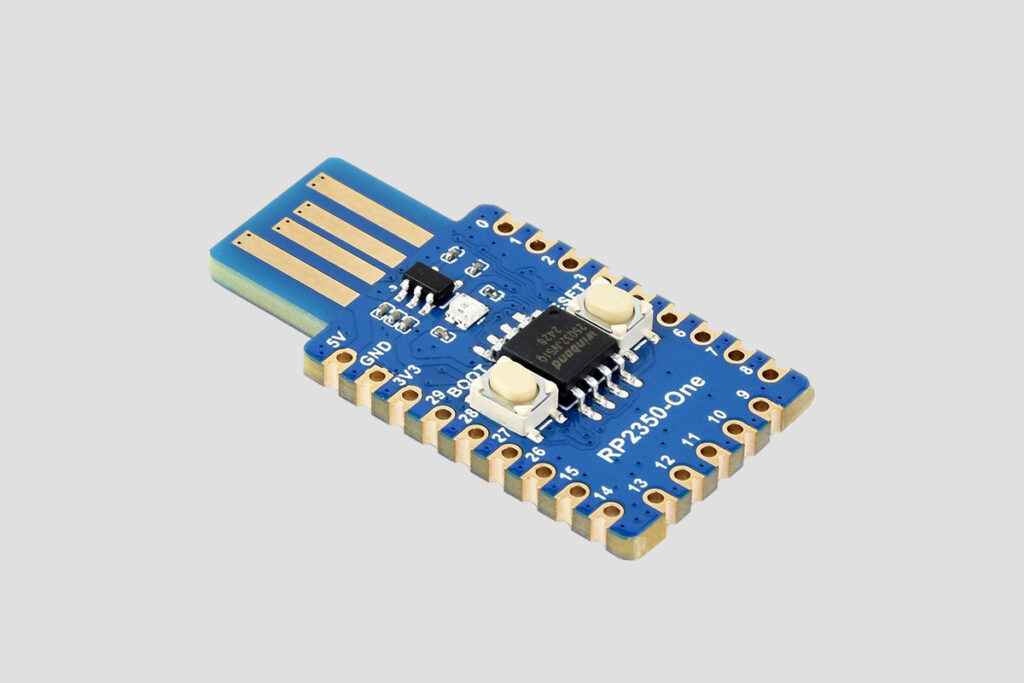
A new compact development board by Waveshare, built around the RP2350A microcontroller, is positioning itself as a flexible platform for embedded prototyping, combining dual-architecture processing with a plug-and-play design.
At its core, the board integrates a hybrid MCU that combines the Arm Cortex-M33 and Hazard3 RISC-V cores, allowing developers to switch between architectures based on workload or software ecosystem needs. The chip runs at up to 150 MHz and is paired with 520KB of SRAM and 4 MB of onboard flash, providing enough headroom for typical IoT and embedded applications.
The key features are:
- Dual-core Arm Cortex-M33 + dual-core RISC-V architecture
- Up to 150 MHz clock speed
- 520KB SRAM + 4MB onboard flash
- USB Type-A plug with host/device support
- ~29 GPIOs with multiple communication interfaces
The board adopts a minimalist, USB Type-A plug form factor, enabling direct connection to host systems without cables or adapters. This approach simplifies deployment for quick testing, firmware flashing, and portable projects. USB 1.1 host and device support further expands its utility for peripheral communication and debugging. Designed with integration in mind, the module features castellated edges for surface-mount applications, enabling direct embedding on custom carrier boards. This makes it suitable for both rapid prototyping and transitioning designs into production hardware.
In terms of I/O, the board exposes nearly 30 GPIO pins, supporting common interfaces such as SPI, I2C, and UART. These capabilities, combined with programmable I/O (PIO) and PWM channels available on the RP2350 platform, enable developers to build custom peripherals and real-time control systems. Low-power modes, including sleep and dormant states, are also supported, making the board viable for battery-powered and energy-sensitive applications. The drag-and-drop programming feature over USB mass storage lowers the barrier to entry, especially for beginners and rapid iteration workflows.
Overall, the board extends the Pico-style ecosystem with added architectural flexibility, enabling developers to experiment with both Arm and RISC-V environments on a single, compact platform.