Low-power maritime IoT can operate reliably across long ocean distances, opening the door to dense sensor networks for safety, weather, navigation and environmental monitoring.
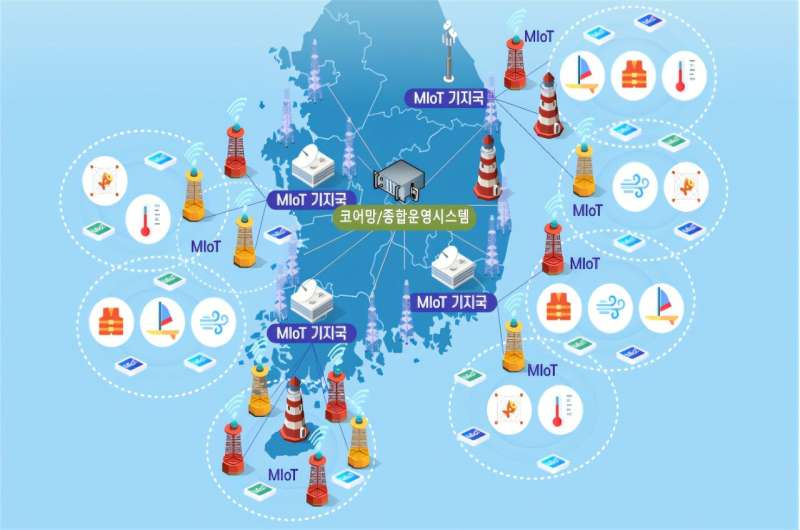
Korean researchers have completed the first real-world validation of a maritime Internet of Things (MIoT) network—an achievement that establishes long-range, low-power ocean connectivity as technically feasible outside controlled trials. The system enables distributed sensors on vessels, buoys, ports and marine facilities to feed continuous data for navigation safety, ecological monitoring and next-generation maritime digital services.
The project, led by the Electronics and Telecommunications Research Institute, deployed a standards-based MIoT network across the West and South Seas and achieved stable links over distances up to 35 km. It marks the first time that 3GPP-defined IoT standards have been tested directly in open waters, demonstrating that land-focused narrowband IoT technologies can be adapted into standalone maritime networks.
At the heart of the rollout is a 450 MHz dedicated public-safety band secured last year. Using this spectrum, researchers built an independent network integrating base stations, terminals, a core network and application-layer services. In Yeosu, a base station at Odongdo Lighthouse connected 30 MIoT terminals spread across six sites, transmitting real sensor data. A second deployment in Gunsan extended the network to multiple lighthouses, with long-distance links—27 km and 35 km—verified between lighthouse-to-port endpoints.
During operation, terminals reported GPS locations, light status, battery levels and shock events every three minutes. Simultaneous connectivity scaled cleanly: all 30 devices at Aids to Navigation sites connected without disruption, and commercial test gear showed the system can support up to 1,000 nodes concurrently. The MIoT implementation differs from existing LTE-Maritime systems by optimizing for low-power, low-cost sensors rather than high-bandwidth data transfers, making it suitable for dense deployments across fishing grounds, aquaculture zones, small-craft safety and uninhabited island management.

With the field validation complete, plans are underway to build pilot MIoT networks across the East, West and South Seas by 2026 and expand nationwide after 2030. Global implications are significant as international bodies accelerate standardization of maritime IoT technologies. The achievement strengthens Korea’s bid to lead emerging MIoT infrastructure, expand maritime big-data ecosystems and support climate-resilience and safety-management initiatives.