Fish muscle signals can reveal movement, sense water flow, and improve robot swimming, offering a new way to design smarter underwater robotic systems.
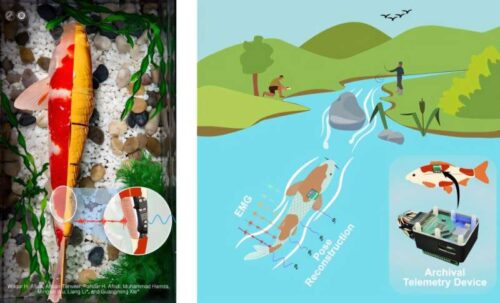
Researchers at Peking University’s Intelligent Biomimetic Design Lab have shown that fish muscle electrical activity can be used not only to reconstruct swimming motion, but also to infer surrounding water flow conditions and improve the design of underwater robots.
The strongest result from the studies is that intramuscular electromyography (EMG) signals in freely swimming fish carry enough information to recover body posture, distinguish flow environments, and predict movement dynamics. A machine learning model trained on these signals was able to reconstruct joint angles and classify whether fish were swimming in steady flow or in vortex-dominated conditions.
To test this, researchers recorded EMG activity from koi and carp using a 16-channel sensing system while simultaneously tracking body motion under different hydrodynamic environments, including laminar flow and vortex streets. A deep neural network mapped muscle signals to body kinematics, enabling full posture reconstruction. The same signals also encoded information about swimming speed and surrounding flow patterns, indicating that muscle activity reflects both movement and environmental forces.
The relationship between muscle activation and motion changed depending on flow conditions. In laminar flow, muscle activity consistently preceded movement, matching a standard propulsion-driven pattern. In vortex conditions, this timing sometimes reversed, with external water forces deforming the body before muscles responded. This suggests that fish muscle activity reflects a coupled system in which movement and environmental sensing are tightly linked rather than separate processes.
A system identification model was trained on synchronized biological EMG and motion data to learn parameters governing tail dynamics, including delay, damping, gain, and natural frequency. When transferred to a robotic fish, the model predicted tail motion without additional training on the robot and outperformed a deep learning baseline.
The findings suggest that muscle signals in fish function as more than simple motor commands. They can encode environmental conditions and support motion prediction, offering a design principle for underwater robotics based on integrated sensorimotor dynamics rather than separated sensing and control systems.