

Researchers have developed a flexible 3D bioelectronic device that integrates living brain cells with embedded electronics, opening new possibilities for low-power AI hardware, neuroscience research, and biohybrid computing systems.

Researchers at Princeton University have unveiled a flexible three-dimensional bioelectronic platform capable of integrating living brain cells directly with embedded electronic networks, marking a significant step toward energy-efficient neuromorphic computing and advanced neural interface systems. The technology, known as 3D-MIND, combines soft electronics with biological neurons to create programmable computing structures that mimic aspects of brain function.
Developed by a team at Princeton University, the device uses a microscopic 3D mesh of metal electrodes coated with an ultra-thin flexible epoxy layer. The structure acts as a scaffold around which tens of thousands of neurons can grow naturally, forming dense interconnected neural networks. Unlike conventional brain-cell experiments that rely on flat petri-dish cultures or external probes, the new approach embeds electronics directly within the neural tissue.
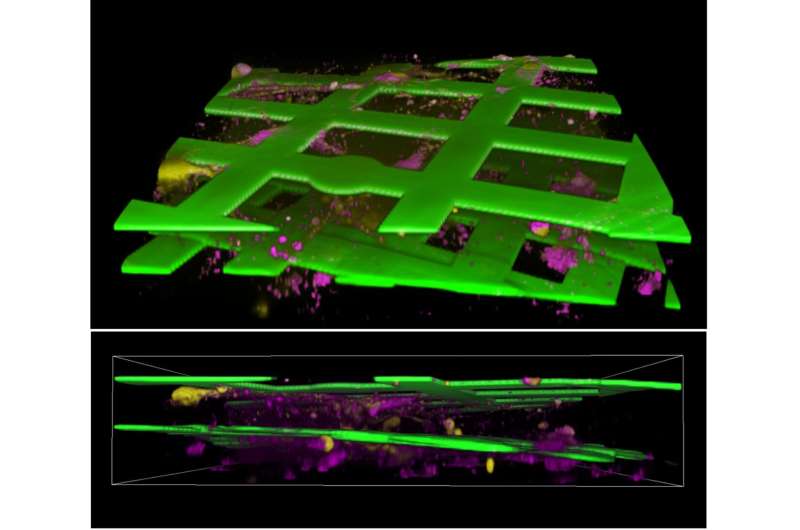
The embedded architecture enables high-resolution recording and stimulation of neuron activity over extended periods. Researchers monitored the networks for more than six months and demonstrated that the system could distinguish between different spatial and temporal electrical patterns after training. The capability suggests potential use in adaptive computing systems inspired by biological intelligence.
One of the project’s major motivations is reducing the energy demands of modern artificial intelligence hardware. Current AI accelerators and data-center processors consume massive amounts of power, while biological brains operate at far lower energy levels. Researchers say biohybrid neural systems could eventually support highly efficient pattern-recognition and learning tasks while consuming only a fraction of the energy required by conventional AI processors. “This work started with a growing challenge in modern AI,” Tian-Ming Fu, senior author of the paper.

The flexible design also improves compatibility with living tissue, an important factor for future biomedical and neural-interface applications. Similar advances in soft hydrogel semiconductors and stretchable electronics are pushing the industry toward electronics that can physically integrate with biological systems without damaging delicate tissues.
Beyond AI hardware, researchers believe the platform could help study neurological disorders, neural development, and drug responses in controlled laboratory environments. The work further highlights the growing convergence of semiconductor engineering, flexible electronics, and synthetic biology in next-generation computing technologies.